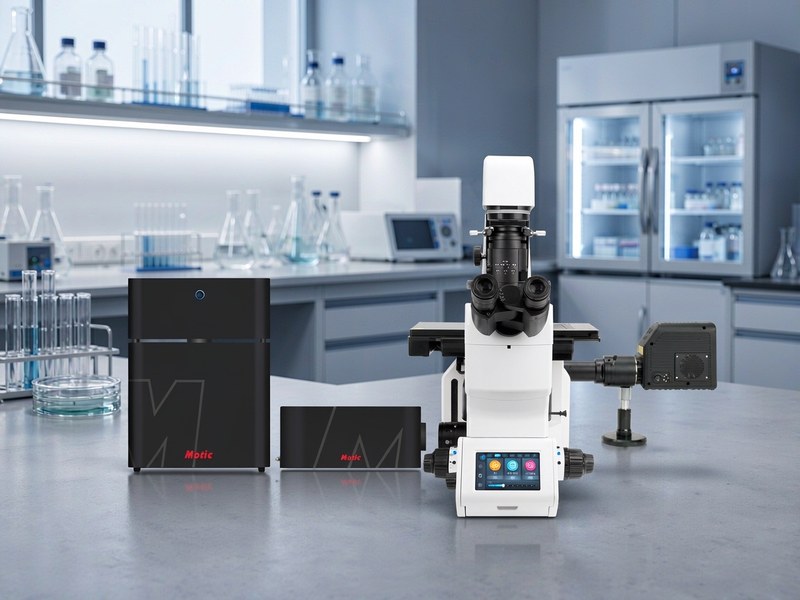
Vertex LS70 Laser Scanning Confocal Microscope
Model: Vertex LS70The Vertex LS70 laser scanning confocal microscope covers routine confocal imaging for universities, medical schools and biopharma laboratories, handling fixed sections, live cells and 3D reconstruction on one system. A 25 mm scan field, 8192 x 8192 pixels and 120 nm XY super-resolution work with a fully motorised inverted stand and Uplan APO objectives, with four lasers acquired simultaneously.
Specifications
| Spectral scanning and unmixing | Not available on this model |
|---|---|
| Max scan resolution | 8192 x 8192 |
| Scan speed | 8 fps at 512 x 512; up to 30 fps with resonant scanner |
| Super-resolution (deconvolution) | XY 120 nm, Z 300 nm |
| Scan field | 25 mm, 360 degree rotation |
| Bit depth | 16 bit |
| Scan modes | X, Y, Z, lambda, T in any combination |
| Pinhole | Fixed 30 um / motorised continuous / custom fixed |
| Lasers | 405, 488, 561, 640 nm standard at 50 mW each; optional 445, 520, 594, 785 nm |
| Detectors | 4 multi-alkali PMTs, QE >= 28% at 500 nm; GaAsP option, QE >= 45% |
| Transmitted detector | 1 channel, simultaneous brightfield / phase capture with automatic merge |
| Host microscope | PX55 FS8 Plus fully motorised inverted stand |
| Observation modes | Brightfield, phase contrast, fluorescence, DIC, Hoffman, polarisation |
| Eyepiece | 10X / 25 mm ultra-wide field |
| Objective nosepiece | Motorised six-position, coded |
| Condenser | Motorised seven-position long working distance, NA 0.55, WD >= 27 mm |
| Stage | Motorised, 120 x 80 mm travel, repeatability <= 1 um, step 0.05 um |
| Z drive | Motorised, 13 mm travel, 10 nm step |
| Transmitted illumination | 10 W LED |
| Fluorescence illumination | 3 or 7 channel LED (350-700 nm, >= 20000 h) or 130 W metal halide |
| Filter turret | Motorised eight-position, magnetic cubes; DAPI / FITC / TRITC included |
| Objectives | Uplan APO 4X/0.16, 10X/0.45, 20X/0.80, 40X/0.95, 60X/1.42 Oil, 100X/1.45 Oil |
| Software | 2D/3D imaging, large-area stitching, live-cell time lapse, FRAP, deconvolution, colocalisation, AI cell segmentation and tracking |
| Workstation | Windows 11 with GPU accelerator |
| Environment | 10-20 C, humidity <= 60% non-condensing |
Features
- 25 mm scan field with 8192 x 8192 pixels, one large image instead of repeated stitching
- Four lasers at 405/488/561/640 nm, 50 mW each, expandable to 445/520/594/785 nm
- Four multi-alkali PMTs at QE >= 28% at 500 nm, with GaAsP option rated QE >= 45%
- 120 nm XY and 300 nm Z super-resolution through adaptive iterative deconvolution on GPU
- 8 fps at 512 x 512, up to 30 fps with the resonant scanner, enough for dynamic events
- Scan head bolted directly to the stand with no fibre link, preserving photon efficiency and long-term stability
- Fully motorised: six-position nosepiece, seven-position condenser, motorised stage and 10 nm Z step
- Software covers deconvolution, 3D rendering, large-area stitching, FRAP, colocalisation, AI segmentation and tracking, with an offline perpetual licence
- Local engineers handle installation, calibration and on-site training, with service response based in Zhengzhou
Applications
- Cell biology and genetics practicals in university life science faculties
- Fluorescence imaging for pathology, anatomy and morphology research in medical schools
- Live-cell dynamic observation in pharmacology and drug screening
- Fluorescent samples of plant cells, root tips and leaf tissue
- Z-stack sectioning and 3D reconstruction of neuroscience tissue sections
- Multiplex immunofluorescence and quantitative protein colocalisation
- Histological evaluation of disease model animals
- Imaging and analysis platforms in biopharma companies and CROs
- Confocal slots in university core facility shared instrument programmes
- Advanced imaging demonstrations in teaching centres
Frequently Asked Questions
How do I choose between LS70 and LS90?
It comes down to spectral scanning. With fixed dye panels and non-overlapping channels, LS70 is enough; for samples with strong autofluorescence or overlapping dye spectra, choose LS90.
How is 120 nm achieved?
Through adaptive iterative deconvolution on a precise PSF model, accelerated on GPU. It is computational super-resolution, not single-molecule localisation like STORM or PALM, so no special probes are required.
What are the installation requirements?
An anti-vibration table, an ambient temperature of 10-20 C, humidity below 60% non-condensing, and roughly 1.5 m of bench width for the stand plus the laser control box.
Want the full specification sheet?
Leave a number and we will send the specification sheet and a quotation for the Vertex LS70 Laser Scanning Confocal Microscope.