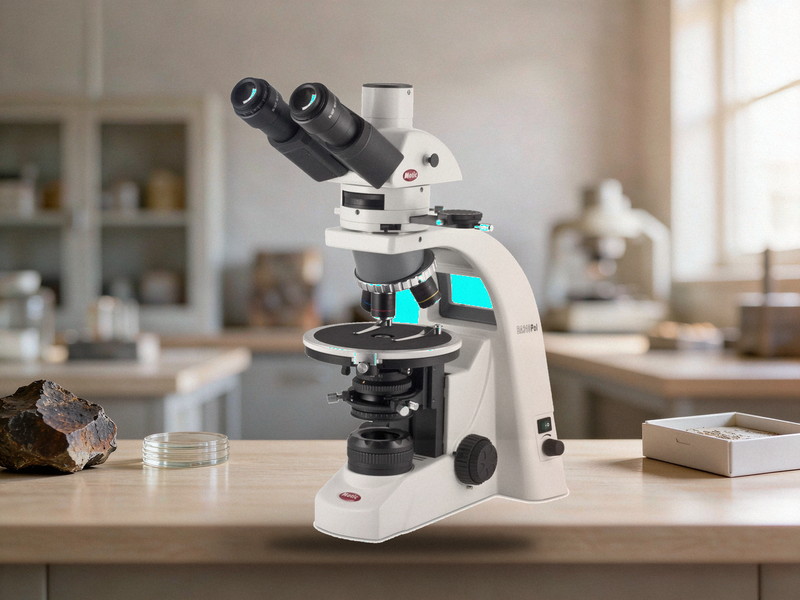
BA310Pol Polarizing Microscope
Model: BA310PolA strain-free polarizing microscope built on the BA310 platform. The standard model is configured for transmitted polarized light; the +EPI version adds reflected illumination and long working distance plan objectives, so thin sections and opaque specimens can be handled on one instrument — suited to petrography, mineralogy and materials or electronics inspection.
Specifications
| Optical system | Infinity-corrected CCIS system, broadband-coated EC strain-free plan objectives, lead-free optics (RoHS) |
|---|---|
| Eyepiece | Plan wide-field high-eyepoint 10X/20mm, diopter adjustable; one eyepiece with cross reticle |
| Observation tube | Hinged binocular, 30° inclined, interpupillary 55–75mm; hinged trinocular, 30° inclined, split 100:0 / 20:80 |
| Objectives (transmitted) | Strain-free EC Plan 4X/NA0.10/WD15.9, 10X/NA0.25/WD17.4, 20X/NA0.45/WD0.9 (optional), 40X/NA0.65/WD0.6 (spring), 60X/NA0.80/WD0.35 (spring) |
| Objectives (reflected, +EPI) | LM Plan long working distance 5X/NA0.15/WD11.72, 10X/NA0.30/WD16.00, 20X/NA0.40/WD12.00, 50X/NA0.55/WD9.15 (spring), 100X/NA0.80/WD2.00 (optional) |
| Nosepiece | Internal-centerable 4-position nosepiece (5-position on +EPI); every objective centerable with the supplied wrench |
| Stage | 360° circular rotating stage, φ160mm, vernier reading 0.1mm, precision ball-bearing rotation, with specimen clips |
| Condenser | Achromatic swing-out strain-free condenser N.A.0.90/0.13 |
| Focusing | Coaxial coarse/fine focus, fine travel 0.2mm per turn, graduation 0.002mm, adjustable coarse tension with focus stop |
| Intermediate body | Built-in centerable Bertrand lens, 360° rotating analyzer, compensator slot |
| Polarizer | Mounted on the condenser carrier, 360° rotatable with 90° positioning |
| Compensators | λ (first-order red), 1/4λ, quartz wedge (grades I–IV), empty slot |
| Illumination | 6V/30W halogen transmitted Köhler illumination with adjustable field and aperture diaphragms; the +EPI version adds 12V/50W halogen reflected illumination with optional 4500K / 6000K LED modules |
| Digital expansion | Trinocular port accepts 2.5X / 4X photo eyepieces and 0.35X–1X camera adapters |
Features
- Strain-free optical path — no artificial interference colours in polarized observation
- CCIS infinity-corrected system whose tube-lens design removes lateral chromatic magnification error
- Centerable EC Plan strain-free objectives stay centred after every magnification change
- 360° rotating φ160mm stage with 0.1mm vernier and smooth ball-bearing movement
- Bertrand lens, 360° analyzer and a full λ / 1/4λ / quartz-wedge compensator set for conoscopy and semi-quantitative work
- Polarizer rotates 360° with 90° positioning for fast crossed-polar alignment
- Transmitted Köhler illumination with field and aperture diaphragms for reduced stray light and higher contrast
- Optional +EPI version covers both transparent and opaque specimens in one instrument
- 20:80 trinocular split for digital photomicrography and imaging add-ons
Applications
- Petrographic thin sections and mineral birefringence examination
- Ore-phase analysis of metals, ceramics and coatings
- Polarized observation of liquid crystals, films and fibres
- Semiconductor and electronic component defect inspection
- Crystal morphology identification in chemicals and building materials
- University teaching and research in geology, materials and biomedical science
Frequently Asked Questions
How is a polarizing microscope different from a biological one?
It adds two polarizing filters and a 360-degree rotating graduated stage. Between crossed polars isotropic materials such as glass, water and amorphous polymers stay dark, while anisotropic materials such as crystals, fibres and stretched plastics brighten and show interference colours.
What samples can it examine?
Rock and mineral thin sections, polymer spherulites and crystallinity, liquid crystal alignment, starch grains (which show a black cross), asbestos fibres, drug polymorphs, and residual stress in glass and moulded parts.
What camera do I need for photography?
A trinocular head with a standard microscope camera is enough. The objectives must be strain-free, though: residual stress in ordinary lens glass produces false interference colours.
Why must the stage rotate?
Extinction angle, sign of elongation and changes in interference colour are all judged by rotating the stage. A graduation readable to 0.1 degree is worth having.
Want the full specification sheet?
Leave a number and we will send the specification sheet and a quotation for the BA310Pol Polarizing Microscope. Calls returned within 10 minutes on working days.