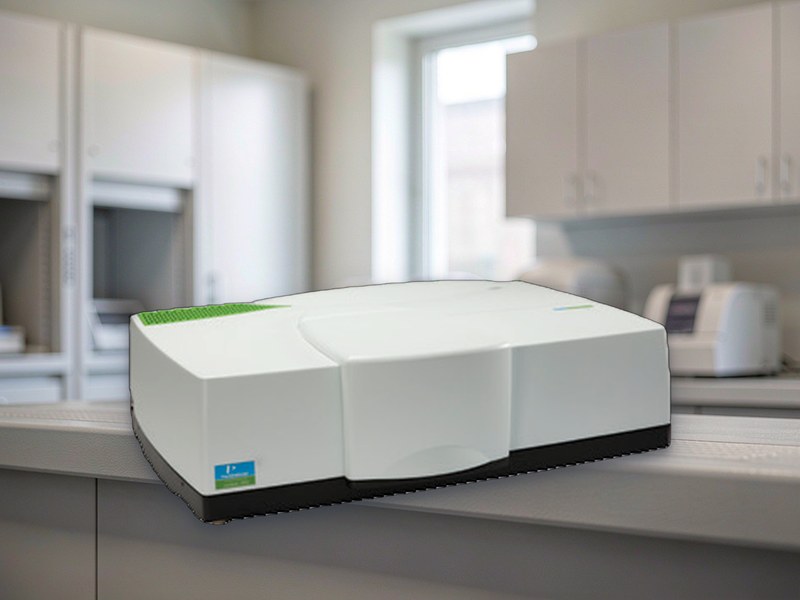
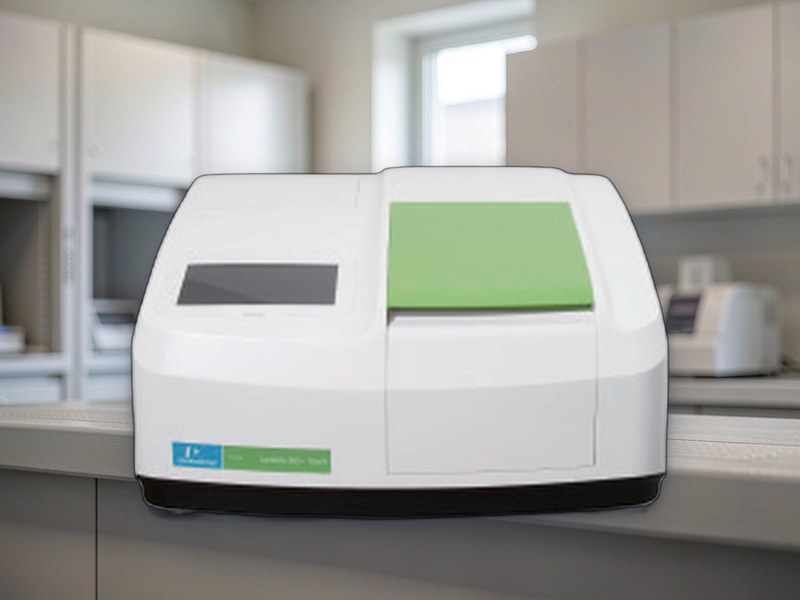
Filters, Coatings, PV Films: Why Optical Testing Has to Reach 3300 nm
Every optical material passes a gate before shipping: transmittance, reflectance, absorption edge. Behind those numbers sits a UV/Vis/NIR spectrophotometer.
1. Three metrics, three physical quantities
Transmittance T is the fraction of light surviving the sample, the direct measure of how well a filter, lens or glass passes light.
Reflectance R is the fraction reflected from a surface, which sets the performance of mirrors, coatings and AR layers.
Band gap Eg is the energy corresponding to the longest wavelength a semiconductor or thin film can absorb, usually extrapolated from the absorption edge and expressed in electron volts.
All three rest on one curve: the absorption spectrum. So the instrument's first job is to measure that curve accurately across the required range.
2. Why the range has to reach 3300 nm
The UV region from 190 to 400 nm captures electronic transitions; the visible from 400 to 780 nm carries colour and transmission; the near-IR from 780 to 3300 nm covers the NIR response of PV films and silicon wafers, the infrared reflectance of architectural and low-E coated glass, and overtone and combination bands of many organics.
A conventional UV/Vis instrument stopping at 1100 nm cannot characterise PV and coating materials properly. That is exactly the dividing line between UV/Vis and UV/Vis/NIR platforms.
3. Stray light: the silent killer
Stray light is light reaching the detector that should never have arrived.
With high-absorbance samples or deep-cutoff filters, stray light lifts a transmittance that should sit near zero, manufacturing a false blocking depth.
Good instruments hold stray light in the 0.0001 %T range or below — for example 0.00007 %T at 220, 340 and 370 nm — which is what makes absorbance above 4 A meaningful.
The test is simple: run a certified cutoff filter and see how low the curve goes in the blocking band.
4. Sample form dictates accessories
Liquids go in standard cuvettes, with path length kept consistent.
Films and glass can be clamped directly, but the angle of incidence must be controlled since oblique incidence changes the path.
Powders and rough surfaces require an integrating sphere; without it, scattered light is under-collected and reflectance reads low.
Multi-angle reflectance needs a variable-angle accessory, clamping once and scanning 0 to 90 degrees for coating uniformity and angular behaviour.
5. Matching the platform to the job
For routine quantitation — nucleic acids and proteins, water quality, food indices — a 190 to 1100 nm UV/Vis is enough. Look at bandwidth options, absorbance ceiling and software compliance.
For optical components, coatings, photovoltaics and displays, a UV/Vis/NIR covering 175 to 3300 nm is required. Look at stray light, linearity and accessory expandability.
Within a series, photodiode-array models suit fast kinetics and dissolution; double-beam models suit long stable runs and high-precision quantitation.
Summary
The difficulty in optical testing is not measuring a curve, it is measuring a curve that is accurate and comparable. Range, stray light and accessory capability are the three questions to ask when specifying.