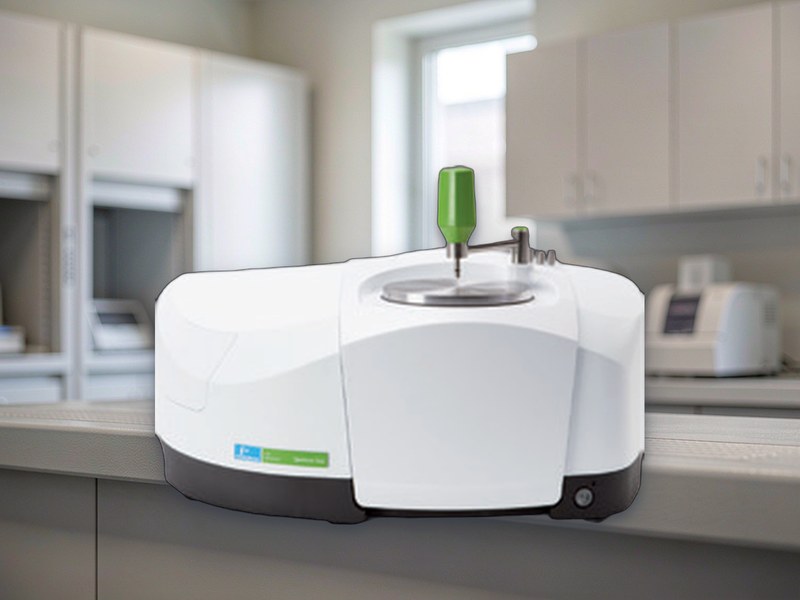
Choosing an FT-IR Spectrometer: What the Three Key Numbers Really Mean
Datasheets for FT-IR spectrometers are long, but three numbers shape almost every day of use. Understand them and the specification exercise becomes simple.
1. Spectral range: what it covers
The range is really a statement about which chemical bonds vibrate in it. A standard configuration covers the mid-IR fingerprint region from 4000 to 400 cm⁻¹, where most organic skeletal and functional-group absorptions sit.
A wider 8300–350 cm⁻¹ platform reaches into the near-IR and the edge of the far-IR, useful for overtones in water-containing samples, some inorganic fillers and low-frequency metal oxide modes.
The stated range depends on the beamsplitter and detector fitted. A KBr beamsplitter is broad but moisture-sensitive; a ZnSe window resists humidity at the cost of part of the high-wavenumber region. In humid regions this trade-off is a real decision.
2. Resolution: higher is not automatically better
Resolution decides whether two closely spaced peaks can be separated.
For routine identification — polymer grades, pharmaceutical excipients, incoming goods — 4 cm⁻¹ is enough, and it scans fast with good signal-to-noise.
Higher resolution matters only when peak shape carries the information: polymorph differences, hydrogen bonding, amide I band fitting for protein secondary structure.
Each step up in resolution roughly doubles the scan time needed for the same signal-to-noise. Choose resolution from the peak widths you actually deal with, not from the maximum the instrument can reach.
3. Signal-to-noise: read the conditions
A quoted signal-to-noise ratio always comes with conditions, typically "5 s, peak-to-peak". The same 14500:1 figure means something very different if it was measured as a one-minute average.
For trace work, what matters is signal-to-noise per unit time — the balance between scan speed and co-added scans.
For fast screening, one spectrum per second with automatic library matching is often more valuable than a headline ratio.
4. Two details that get overlooked
Moisture first. KBr beamsplitters in the optical path dislike water, and a sudden loss of energy in the rainy season is a common failure. An optical moisture barrier with long-life desiccant saves a great deal of maintenance.
Second, atmospheric compensation. Water vapour and CO₂ absorption bands interfere with spectra, especially CO₂ near 2350 cm⁻¹. Real-time background compensation is cleaner than subtracting spectra afterwards and avoids introducing false peaks.
Summary
Before choosing an FT-IR, settle three questions: is the work routine identification or trace analysis, is the lab humid, and will the platform later connect to an IR microscope or a TGA. Once those are answered, range, resolution and accessories follow naturally.