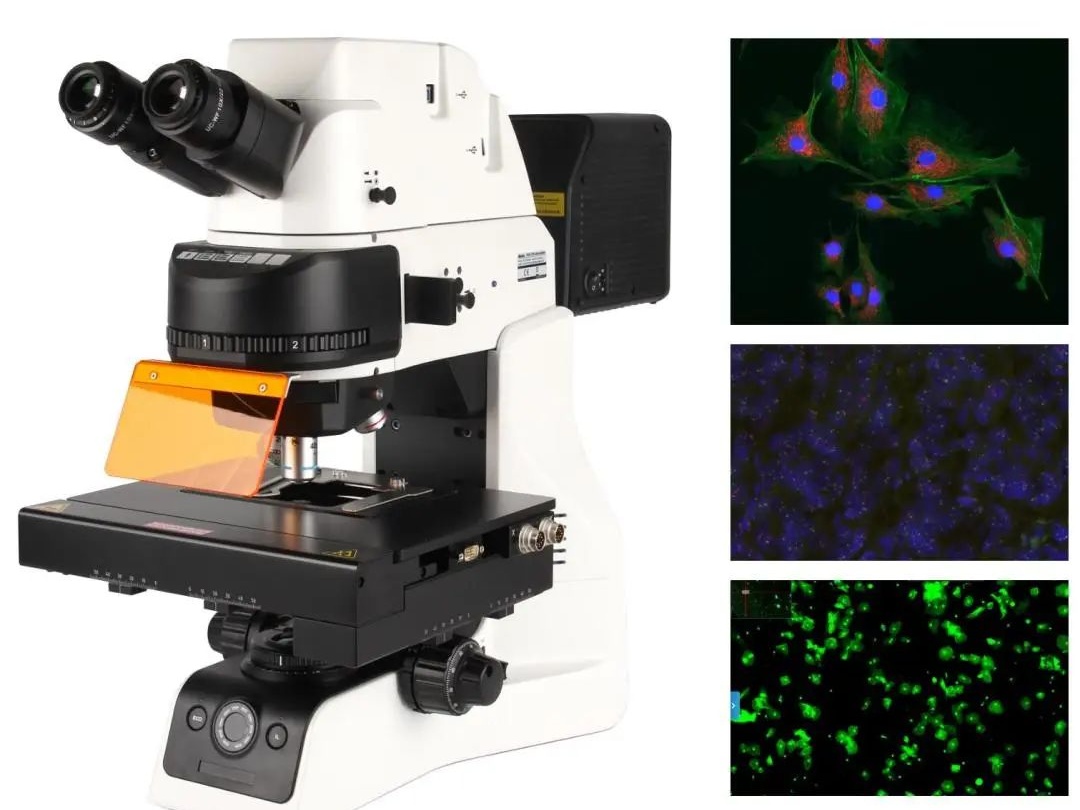
PA53 FS6 Inverted Fluorescence Microscope
Model: PA53 FS6The PA53 FS6 is a research-grade upright fluorescence microscope equipped with a CCIS infinity chromatic aberration-corrected optical system and a LUMOS high-brightness LED fluorescence light source. It supports multichannel fluorescence imaging and is suitable for research observation of various biological samples such as sections and smears.
Specifications
| Optical system | CCIS infinity chromatic aberration-corrected optical system |
|---|---|
| Eyepiece | 10X/23, 30° hinged trinocular observation tube, interpupillary distance 52-76mm |
| Focusing travel | Coarse 37mm / turn, fine 0.1mm / turn, minimum fine graduation 0.002mm |
| Illumination | Köhler transmitted halogen illumination + LUMOS high-brightness LED epi-fluorescence light source |
| Fluorescence module | 6-position coded fluorescence filter turret, standard DAPI, FITC, TRITC filter sets, supporting custom expansion |
| Stand body | Research upright body, connectable to an external controller, supporting multi-mode switching, with a stray-light shielding design |
Features
- CCIS infinity optical system with a large field of view, high imaging resolution, and excellent color reproduction
- 6-channel coded fluorescence turret for fast switching among multicolor fluorescence channels, compatible with special filter sets such as FISH
- LUMOS LED fluorescence light source, ready to use without warm-up, long lifespan, with adjustable light intensity per independent channel
- Multiple stray-light shielding structures reduce fluorescence background interference for a high imaging signal-to-noise ratio
- Supports multiple observation modes such as brightfield, phase contrast, and polarized light for versatile use
- Trinocular camera port for expanding to a digital imaging system and professional image analysis software
Applications
- Fluorescence observation of tissue sections, paraffin sections, and cell smears
- Immunofluorescence, FISH (fluorescence in situ hybridization), and pathological sample analysis
- Molecular biology, morphology, and oncology research experiments
- University life science colleges, medical schools, research institutes, pharmaceutical pathology laboratories, and third-party medical testing institutions