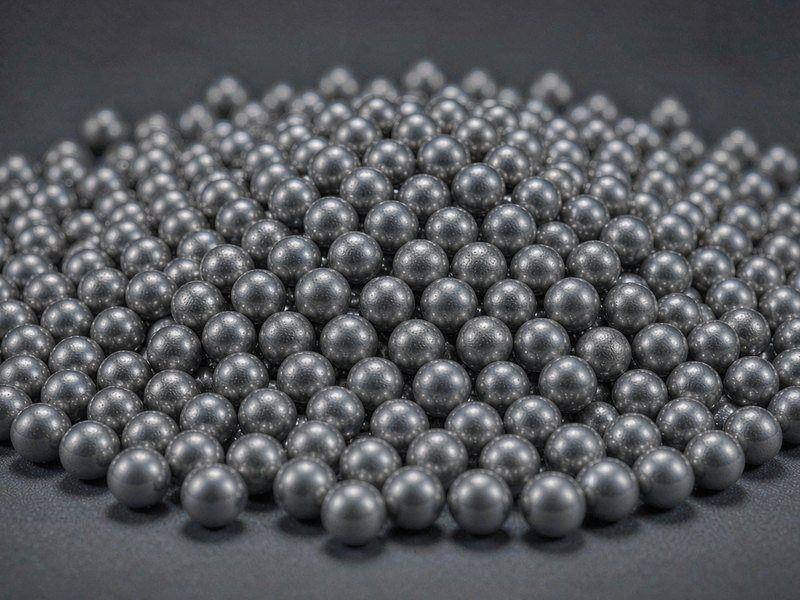
Metal Powders for Additive Manufacturing
Model: 全系列Six material families — titanium alloys, nickel-base superalloys, aluminium alloys, tool and stainless steels, cobalt-chromium alloys, and copper alloys — with more than forty grades held in stock and over two hundred available across the range. Particle sizes from 0–20 to 105–250 μm are cut to suit the process, produced by EIGA, VIGA or PREP atomisation with high sphericity, low oxygen and consistent batches.
Specifications
| Material families | Titanium alloys, nickel-base superalloys, aluminium alloys, tool and stainless steels, cobalt-chromium alloys, copper alloys |
|---|---|
| Grades in stock | Over 40, expandable to more than 200 across the range |
| Particle size | 0–20, 15–45, 15–53, 45–105, 53–150, 105–250 μm, cut to machine and process |
| Atomisation | EIGA, VIGA, PREP plasma rotating electrode, plasma spheroidisation |
| Compatible processes | LPBF (SLM), EBM, DED and laser cladding, MIM, HIP, thermal spray |
| Sphericity | 0.95 or above, typically beyond 0.97 |
| Oxygen content | Nickel-base ≤200 ppm; titanium ≤1000–1200 ppm; steels ≤300–500 ppm; aluminium ≤1000 ppm |
| Batch documentation | Chemistry, particle size distribution, apparent and tap density, Hall flow, oxygen and nitrogen |
| Packaging | 5 kg drum, 10 kg carton, customised on request |
Grade Performance
| Grade | Material | Particle size (μm) | Oxygen | Tensile (as built) | Typical applications |
|---|---|---|---|---|---|
| TC4 | Ti-6Al-4V | 15–53 | ≤1100 ppm | 1080±50 MPa | Aerospace structures, implants, phone mid-frames |
| TC4 ELI | Ti-6Al-4V ELI | 15–53 | ≤1000 ppm | — | Medical implants |
| TA15 | Ti alloy BT20 | 15–53 | ≤1200 ppm | 1020±50 MPa | Aerospace load-bearing structures, engine flanges |
| TC11 | Ti alloy | 15–53 | ≤1000 ppm | — | Compressor discs and blades below 500 °C |
| TA1 | Commercially pure Ti | 15–53 | ≤1000 ppm | — | Chemical plant, corrosion-resistant structures |
| Ti2AlNb | Ti aluminide | 15–53 | — | — | Lightweight structures for 650 °C service |
| NiTi50 | Shape memory alloy | 15–53 | ≤600 ppm | — | Cardiovascular stents, radar antennas |
| GH4169 | Ni-base IN718 | 15–53 / 15–45 | ≤200 ppm | 1250±50 MPa at 650 °C | Turbine discs, casings, blades, combustors |
| GH3625 | Ni-base IN625 | 15–53 | — | — | Combustors, chemical plant, marine equipment |
| GH3536 | Ni-base Hastelloy X | 15–53 / 15–45 | ≤200 ppm | 220±10 MPa at 900 °C | Combustors, high-temperature corrosion parts |
| GH4099 | Ni-base | 15–53 | — | — | Aeroengine hot-section parts |
| GH5188 | Co-base superalloy | 15–53 | — | — | Combustors, nozzle guide vanes |
| AlSi10Mg | Al-Si-Mg | 15–53 | ≤1000 ppm | — | Lightweight structures, heat sinks, cooling channels |
| AlSi7Mg | Al-Si-Mg | 10–45 | ≤1000 ppm | — | Thin-wall and fine-feature parts |
| AlMgErZr | High-strength Al | 15–53 | — | ≥520 MPa | Rail transit, aerospace lightweight structures |
| 18Ni300 | Maraging steel MS1 | 15–53 / 15–45 | ≤300 ppm | Around 2000 MPa / 54–56 HRC | Conformal cooling moulds and inserts |
| CX | Stainless steel Corrax | 15–53 | ≤300 ppm | — | Corrosion-resistant mirror-finish moulds |
| 17-4PH | Precipitation hardening stainless | 15–53 | — | — | High-strength corrosion-resistant parts |
| 316L | Austenitic stainless | 15–53 | ≤500 ppm | — | Chemical, food, medical, marine |
| CoCrMoW | Co-Cr-Mo-W | 15–53 / 15–45 | ≤300 ppm | 1025±50 MPa | Dental crowns and bridges, orthopaedic implants |
| CoCrMo | Co-Cr-Mo | 15–53 | ≤500 ppm | — | Dental frameworks, joint prostheses |
| CuCrZr | Cu-Cr-Zr | 15–53 | — | — | Liquid-cooling parts, conductive structures |
| CuSn10 | Tin bronze | 15–53 | — | — | Wear-resistant bearings, decorative parts |
Features
- Six material families and forty-plus grades in stock, covering everything from aeroengine hot-section parts to dental prosthetics
- Atomisation matched to the material: crucible-free EIGA for titanium, avoiding refractory contamination; VIGA for superalloys and steels; PREP where satellite content must be minimal
- Tiered oxygen control: ≤200 ppm for nickel-base, ≤1100 ppm for titanium, ≤300 ppm for steels — the decisive figures for hot-section parts and implants
- Particle sizes from 0–20 to 105–250 μm: fine cuts for SLM and MIM, mid cuts for LPBF, coarse cuts for cladding and HIP
- Sphericity above 0.95 with few satellites for even recoating and stable as-built density
- Every batch ships with a test report: chemistry, particle size distribution, apparent and tap density, Hall flow, oxygen and nitrogen
- Composition adjustment and custom particle sizes, from tens of kilograms of trial material to series supply
Applications
- Aerospace: engine blades and casings, turbine discs, load-bearing frames, combustor parts
- Medical and dental: orthopaedic implants, crowns and bridges, surgical instruments
- Automotive and tooling: conformal cooling moulds, lightweight structures, hot-work die inserts
- Consumer electronics: phone mid-frames, watch cases, heat dissipation and liquid-cooling structures
- Research, teaching and remanufacturing: process development, comparative material trials, laser cladding repair of moulds
Frequently Asked Questions
What is the minimum order quantity?
Standard grades ship in 5 kg drums or 10 kg cartons. Special grades and custom particle sizes are confirmed per batch.
Is there a certificate of analysis?
Every batch ships with a test report covering chemistry, particle size distribution, apparent and tap density, Hall flow, oxygen and nitrogen.
Can recycled powder be reused?
Yes, with control of the blend ratio and re-testing of oxygen and particle size. A ratio of 30 to 50 percent is commonly used, depending on the alloy and the part.
How do I match particle size to my machine?
SLM and LPBF typically use 15 to 53 μm, MIM uses 0 to 20 μm, laser cladding and powder feed use 45 to 105 or 53 to 150 μm, and HIP can tolerate coarser cuts.