Choosing a Microscope for a Testing Laboratory: Start from the Report
A testing laboratory does not buy microscopes the way a factory does
A factory buys equipment for throughput. A testing laboratory buys equipment for whether a report can be issued.
The difference is that a report carries external liability. So beyond the instrument itself, calibration status, raw records and image traceability all come under scrutiny.
1. The three things an audit looks at
Whether the equipment is within its calibration period. A microscope is measuring equipment, and where dimensional measurement is involved calibration is essential. Auditors ask for the certificate number, validity and the accreditation of the calibration body. Schedule calibration when the instrument arrives, not the week before an audit.
Whether raw records are traceable. If photographs carry no scale, no sample ID and no acquisition parameters, the chain of evidence is broken. The requirement is not an attractive image; it is proof that this image shows this location on this sample.
Whether personnel are competent. Good equipment operated inconsistently still produces deviations. Training and authorisation records are sampled on site.
2. Three ways microscopes are used in testing work
Qualitative judgement: fibre type, colony morphology, foreign-body identity, coating defects. The conclusion is "what is it", with no number attached, but it must be reproducible. Image records matter most here.
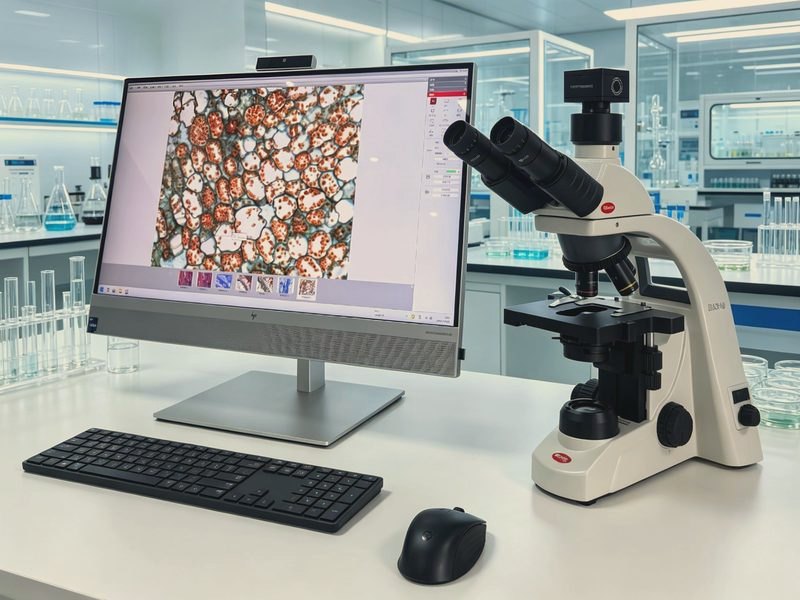
Quantitative measurement: coating thickness, particle size, fibre diameter, defect dimensions. The conclusion is a number, so calibration and measurement uncertainty are central. The software must produce a traceable measurement record.
Supporting evidence: used alongside spectroscopy or chromatography to corroborate a composition finding. Image clarity and consistency of acquisition are what count.
3. Where to spend and where not to
Spend on: objective correction grade, calibration of the imaging system, measurement software, illumination stability.
Save on: extreme zoom ratios, observation modes you will never use, and excessive camera resolution.
A common misconception is that more megapixels is better. For testing work, adequate resolution is enough; what governs measurement accuracy is the resolving power of the optics and its calibration, not the camera specification.
Closing note
Equipment procurement in a testing laboratory is really the translation of report requirements into equipment and record requirements. Translate it well and audits are routine. Translate it poorly and reports come out quickly but do not hold up.
If you are extending your scope or replacing equipment, tell us the test items, the standards you work to and the report format. We will work backwards from those to a configuration and a record plan.