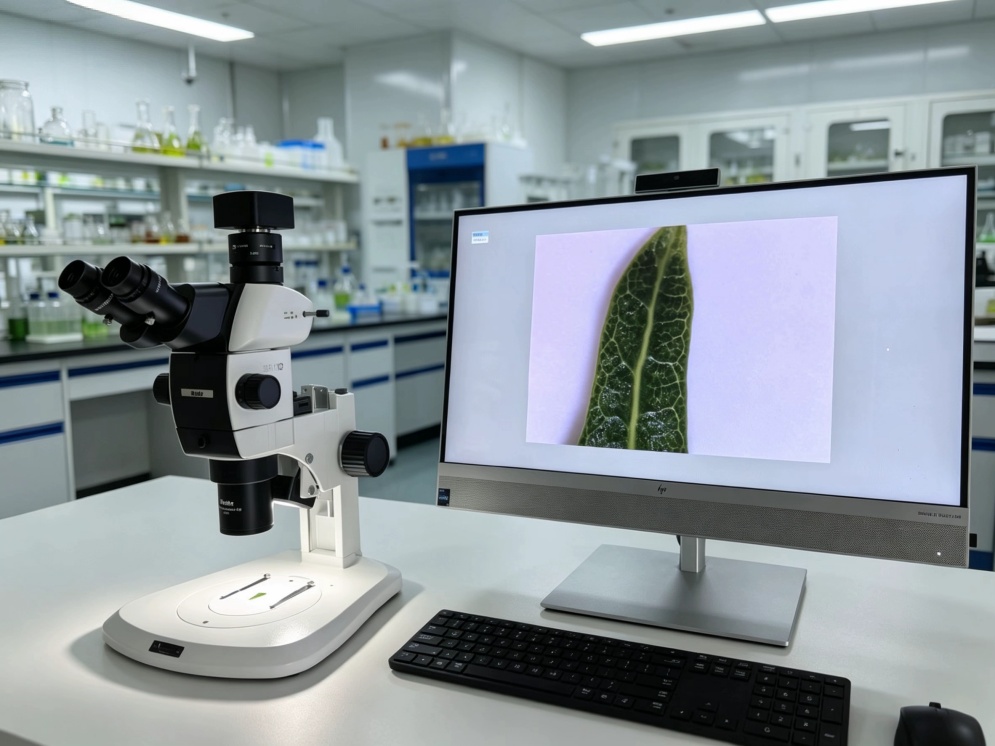
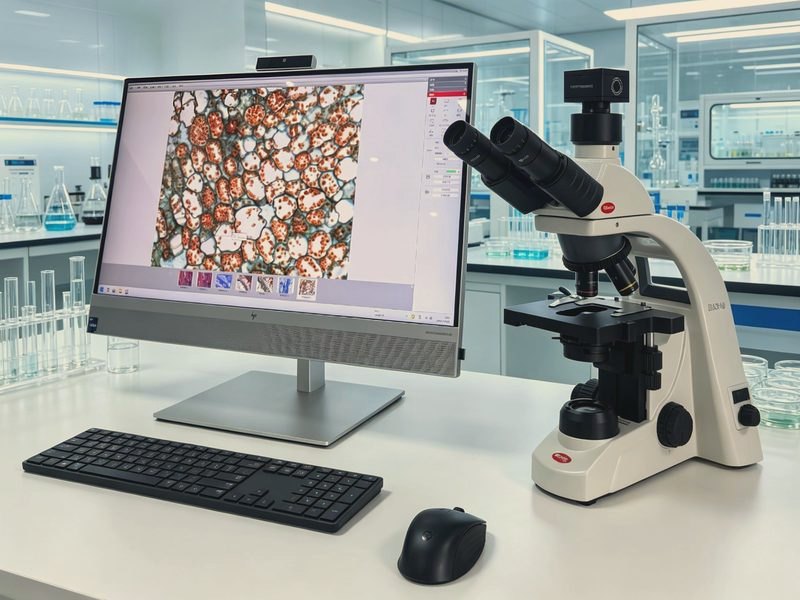
Photographing a Microscope Field with a Phone: Making It Usable as a Record
Can a phone photo through a microscope count as a record
Yes, provided two things are controlled: stability, and a scale.
Phone cameras are good enough to capture a field of view clearly. The problem is the casual shot: hand shake, glare, dark corners, beauty mode switching itself on. The result cannot serve as a record and cannot be compared with anyone else's.
The sequence below is the least fussy reliable way to get usable images in a laboratory.
1. Hold the phone still
This decides the outcome more than any setting. Handheld is marginal at low power and almost always blurred at high power.
The simplest solution is a phone adapter for the eyepiece, which costs very little and clamps the phone in place. Without one, rest the phone on the bench edge, stack books to the right height, and use the timer. What matters is that your hand is not touching the phone at the moment of exposure.
2. Four key actions
Centre on the exit pupil to remove dark corners. The phone lens must sit on the optical axis of the eyepiece. A slight offset produces a bright side and a dark side. Adjust while watching the screen until the field is a complete, evenly lit circle.
Turn off flash, HDR and beauty mode. Flash reflects off the eyepiece and ruins the image; HDR flattens the tonal range and hides real differences; beauty mode removes detail.
Lock focus and exposure. Press and hold on the field in most phones to lock AE/AF. Without locking, brightness and focus drift whenever anything moves.
Use the timer or the earphone shutter. The moment of pressing is when blur happens. Set a three-second timer, or use the volume key on the earphone cable so your hand never touches the screen.
3. The scale cannot be skipped
A micrograph without a scale shows that something exists, not how large it is. Three approaches, in order of reliability: photograph a stage micrometer at the same magnification and archive it alongside the sample image; include a reticle or software scale bar in the frame; or capture the measurement annotation together with the image after measuring in software.
Writing "400x" is not sufficient. Magnification is not size, and two instruments both labelled 400x may have noticeably different field diameters.
4. What to capture
The same field at three magnifications: low for context, medium for structure, high for detail. Archived together, they show the relationship at a glance.
Put the sample ID, location, magnification and date in the filename. Three years later, that line is how the image is found again.
Closing note
Phone photography through a microscope is not a compromise. For inspection rounds, teaching and initial screening it is far faster than setting up a camera. Get stability and scale right and the output is good enough.
If your organisation needs a consistent photography standard, or you are training a group of people, tell us what they currently do and what the images are used for. We will provide a template for your actual workflow, which is easier to adopt than a generic guide.