Motic Wi-Fi 6 Wireless Metallography Classroom Deployed at UPC
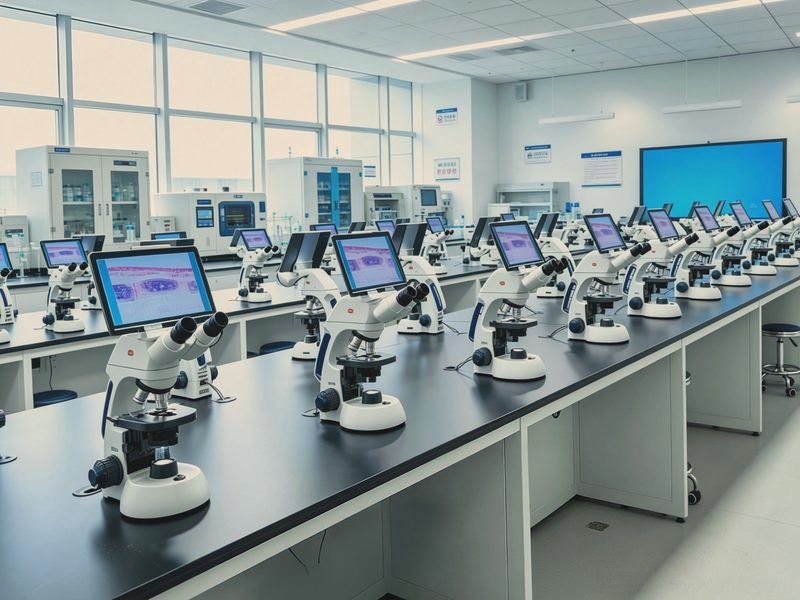
According to an official announcement from Motic, its Wi-Fi 6 wireless intelligent metallography interactive teaching system has completed installation and commissioning at China University of Petroleum (East China) and entered service. The system is installed in the metallographic analysis laboratory of the School of Materials Science and Engineering.
China University of Petroleum (East China) is a national key university directly under the Ministry of Education and a member of the 211 Project, having entered the Double First Class list in both 2017 and 2022. Its School of Materials Science and Engineering has long trained materials students, with metallographic analysis as a core practical skill.
1. Why metallography needs interaction more
Metallographic observation differs sharply from biological observation. Metal samples are opaque and can only be imaged in reflected light, with no coverslip, low field brightness and inherently weak contrast between grain boundaries, phase boundaries and precipitates. Tolerance for exposure and focus error is small.
Traditional laboratory classes follow a one person one microscope pattern. Teachers cannot see each student field of view in real time and must walk between stations, while students struggling with light path, sample preparation or structure interpretation get help late. Outcomes depend heavily on individual ability.
An interactive system changes this by turning separate views into a shared view. The teacher station can pull up any student screen live and annotate the same image on the main display, so students see exactly which structure is being pointed at without leaving their seat. For metallography, where a missed feature leads to a wrong conclusion, this matters more than repeating the theory.
2. Configuration of this deployment
• 4K imaging with 3840 by 2160 still resolution and at least 30 frames per second at full pixel count
• Fully wireless architecture where student terminals receive microscope and macro images over Wi-Fi
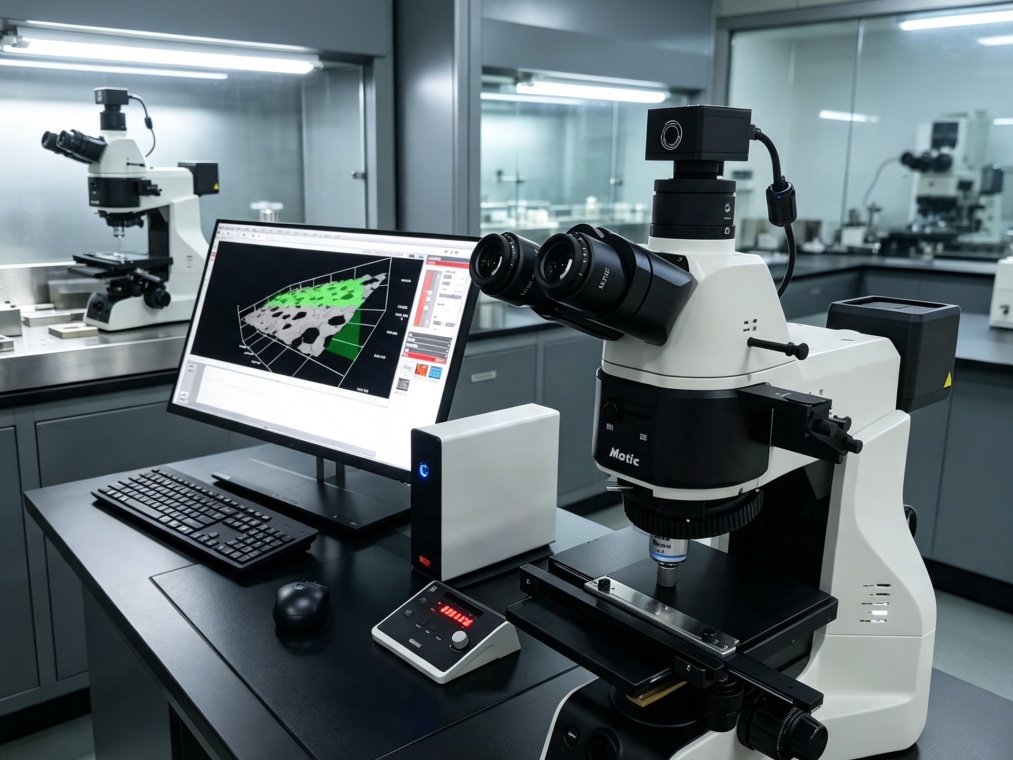
• PA53MET-BD-3D motorised upright metallurgical microscope with autofocus, auto exposure and one touch scanning for seamless panoramic stitching
• AE2000MET inverted metallurgical microscope with high contrast long working distance objectives, brightfield, darkfield and polarised light, up to 1000X
3. Where AI support actually fits
Beyond interaction, the system adds AI assistance for in class questions. Such functions answer repetitive questions so students need not wait, but they do not replace teacher judgement, since structure interpretation and rating standards depend on experience with real samples.
4. Reference value for regional universities
As an authorised Motic partner, SCIDGE serves materials, mechanical and metallurgical departments across Henan and neighbouring provinces. Three points from this deployment are worth borrowing: fix the imaging chain before adding seats in a laboratory renovation, judge an interactive system by whether the teacher truly sees every student field, and pair upright and inverted models so scanning and rating sit alongside long observation of small samples.
Closing
The value of an interactive microscopy classroom is not the number of units but whether the teacher can see what each student is looking at. In metallography a student who misreads a structure will repeat the mistake in the exam unless it is corrected in class, and that is exactly what this deployment addresses.