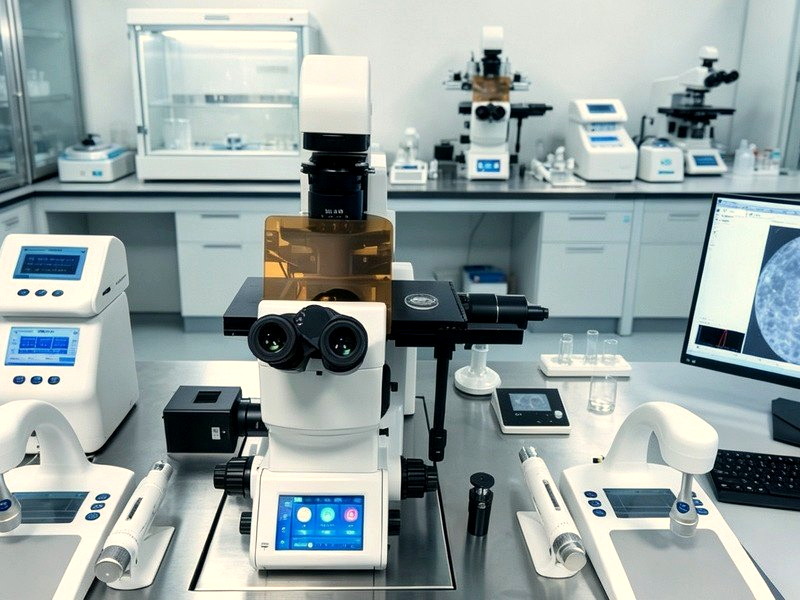
Micromanipulator Specifications
1. Mechanical structure and travel
• Three axes, X Y Z, or four including diagonal or rotation
• Coarse travel of 20 to 25 mm for rapid approach
• Fine travel of 2 to 5 mm by micrometer screw or piezo drive
• Left or right hand configuration, with two arms mountable together
• Rigidity and backlash directly affect positioning repeatability
2. Positioning precision: the key item
• Fine mode steps of 0.1 micrometre or less
• Repeatability of 1 micrometre or better when returning to a target
• Drift of 1 micrometre per hour or less for prolonged work such as nuclear transfer or ICSI
• Oil free mechanisms without backlash are more stable, while hydraulic types need maintenance against leaks
• Note: precision must be measured under working load with a pipette fitted, since unloaded figures mean little
3. Joystick and proportional control
• Three axis coaxial joystick aligned with the direction of travel to reduce misoperation
• Proportional control where pipette travel follows handle travel, with adjustable sensitivity
• One touch switching between coarse and fine
• Foot switch for injection and holding vacuum
• Adjustable damping, since too light causes tremor and too heavy feels vague
4. Injection and holding systems
• Injection by air or oil pressure, or by piezo drive
• Piezo drive suits hard shelled samples such as nematodes and zebrafish embryos
• Adjustable injection volume down to the picolitre range
• Holding pipette vacuum adjustable through a gas tight syringe or oil system
• Capillary holder sizes must match the pipettes in use
5. Microscope compatibility
• Designed for inverted microscopes, with the brand and model interface confirmed
• Usually mounted on the stage sides or a dedicated side plate
• The stage should be fixed or accept an operating platform so it does not shift during work
• Compatibility with incubation stages and heated stages must be checked in advance
• Working distance of a 40X objective must accommodate the pipette angle
6. Vibration isolation and environment
• An anti-vibration table, air or marble, is mandatory
• Away from lifts, compressors, corridors and doors
• No draughts from air conditioning across the working area
• Stable temperature of 20 to 25 degrees Celsius, since drift follows temperature change
• Level floor and levelled instrument
7. Accessories and consumables
• Pipette puller and microforge as companion equipment
• Consumables including injection and holding pipettes and capillaries, with sizes and cost stated
• Automatic pipette change or position memory on some systems
• Cleaning and dust cover kit
8. Power and environment
• Power supply AC 220 V, 50 Hz
• Operating temperature 20 to 25 degrees Celsius, drift within 1 degree per hour
• Relative humidity 40 to 70 percent
• Class 10000 clean room or laminar bench for cell work
• Independent earth required
9. Where procurement goes wrong
• Only micromanipulator is specified without step size or drift, and ICSI or nuclear transfer fails because drift exceeds the working tolerance
• The interface does not match the existing inverted microscope, requiring an adapter plate or a new stand
• No anti-vibration table and no temperature control, so micrometre work cannot be held steady on an ordinary bench