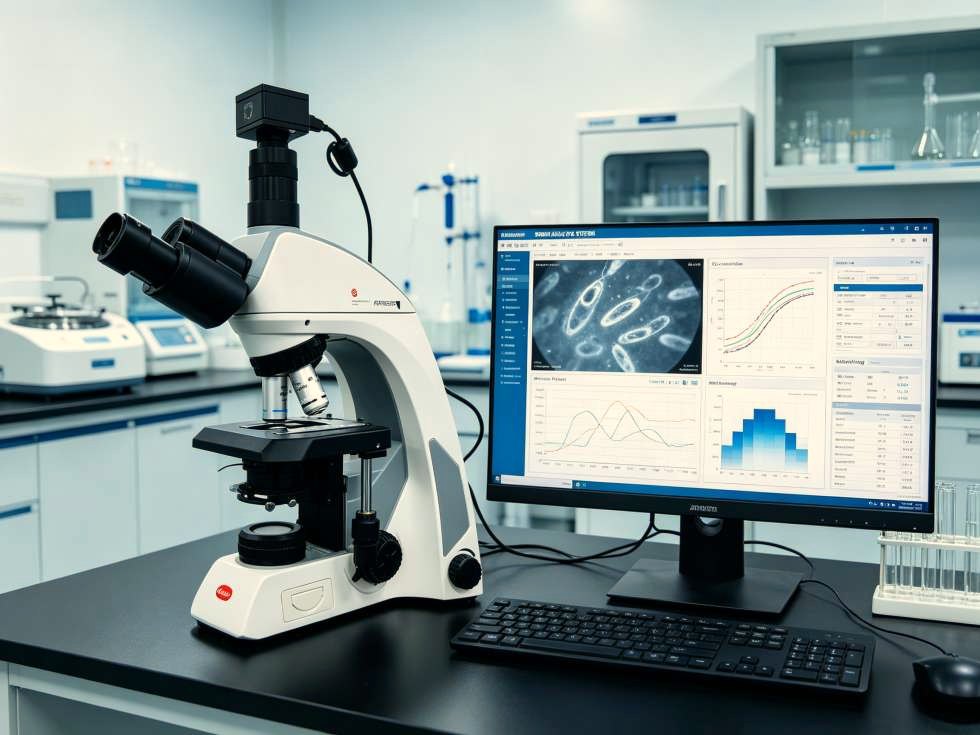
Semen Analysis System Specifications
1. Optics and imaging
• Phase contrast microscope with negative phase, 10X and 20X objectives
• Camera at 60 frames per second or more, since motility analysis cannot resolve speed at lower rates
• Sensor of 2 megapixels or more matched to the field of view
• Heated stage at 37 degrees Celsius within 0.5 throughout the run
• Stable illumination so brightness changes do not shift detection thresholds
2. Concentration and motility: the key item
• Concentration range from 0 to 250 million per millilitre, with automatic dilution above range
• Repeatability of concentration within 10 percent on repeated sampling
• Motility classes per WHO fifth or sixth edition, progressive, non-progressive and immotile
• Motion parameters including curvilinear velocity, straight line velocity, average path velocity, linearity, amplitude of lateral head displacement and beat cross frequency
• Note: motility accuracy follows frame rate and tracking, and fast sperm are underestimated below 60 frames per second
3. Counting chambers and consumables
• Chamber depth of 10 to 20 micrometres, Makler or Leja type
• Disposable or reusable slides with cost per test stated
• Sample volume of 5 to 10 microlitres
• Shallower chambers reduce overlap and focusing problems
• Consumables must match the calibration, and a change of slide type requires recalibration
4. Motion analysis
• Frame by frame tracking with adjustable track length
• Configurable velocity threshold and minimum track length
• Exclusion of debris, round cells and bubbles
• Video replay and manual review for correction of outliers
• Automatic capture across at least five fields to reduce sampling error
5. Morphology
• Classification of head, midpiece and tail defects
• Strict and routine criteria selectable
• Staining by Papanicolaou, Diff-Quik or Shorr, each needing its own algorithm
• Morphology is usually assisted rather than fully automatic, and full automation has limited accuracy
• The output must state assisted or automatic to avoid clinical dispute
6. Software and reporting
• Automatic report covering concentration, total count, motility classes, morphology and motion parameters
• Adjustable reference ranges by WHO edition
• Patient data with trend comparison across visits
• Customisable templates with printing and PDF
• Export to CSV and Excel for research statistics
7. Quality control and calibration
• Regular verification with control material, latex beads or control semen
• Traceable calibration records and intervals
• Inter-laboratory comparison and internal quality charts
• Audit trail and operation logs as required in clinical laboratories
• LIS connectivity
8. Power and environment
• Power supply AC 220 V, 50 Hz
• Operating temperature 20 to 25 degrees Celsius
• Relative humidity up to 70 percent
• Anti-vibration table, since frame by frame tracking is sensitive to it
• The microscope must sit level
9. Where procurement goes wrong
• A 30 frame per second camera underestimates fast progressive sperm, biasing motility low across the board
• No heated stage, so below 37 degrees motility drops and results are not comparable
• Morphology is sold as automatic but needs heavy manual review, so report turnaround is unchanged