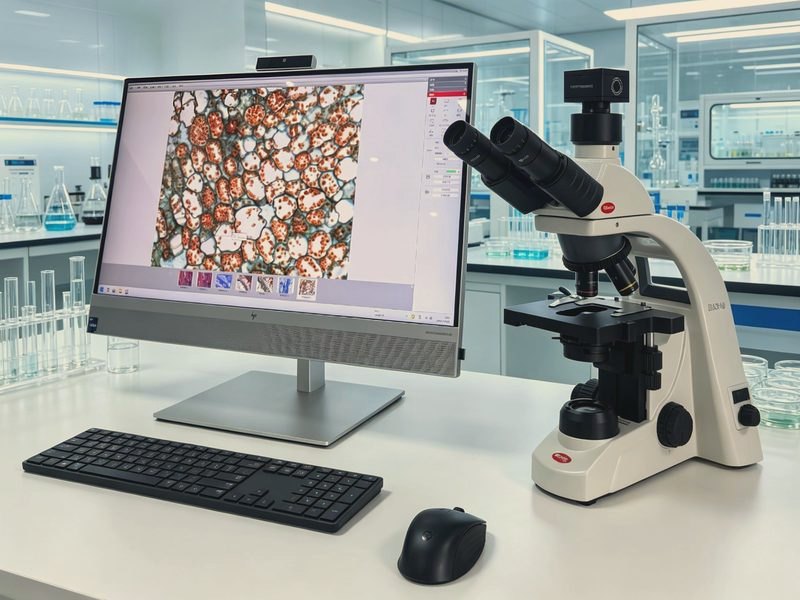
Microscope Camera Specifications
1. Sensor type and optical format: the key item
• CMOS, the mainstream choice, fast and economical for routine brightfield and teaching
• sCMOS, low noise and high dynamic range, for weak fluorescence and quantitative imaging
• CCD with good colour fidelity but slow, now largely superseded
• Optical format of 1 over 2.3, 1 over 1.8, 2 over 3 or one inch, larger giving a wider field and more light per pixel
• Sensor format must match the microscope field number, otherwise the edges are cut off
2. Pixel count and pixel size
• Common steps of 5, 12 and 20 megapixels
• Pixel size from 1.85 to 4.5 micrometres, larger pixels performing better in low light
• High pixel counts with small pixels suit brightfield detail, lower counts with larger pixels suit fluorescence
• Pixel count is not sharpness, which follows pixel size and optical resolution together
• Note: a 40X objective resolves around 0.3 micrometres, so 2 micrometre pixels are already sufficient and more pixels add nothing
3. Resolution and frame rate
• Full frame rates of 15 to 60 frames per second
• Binning or region of interest raises the rate, 2 by 2 binning doubling it while halving resolution
• Exposure range from 0.1 milliseconds to 10 seconds, short for dynamics and long for weak fluorescence
• Frame rate depends on interface bandwidth, and USB 2.0 cannot carry full frame high rates
• Dynamic work such as live cells, sperm or blood flow needs 30 frames per second or more
4. Shutter type
• Rolling shutter, economical but showing skew on fast moving objects
• Global shutter exposing all pixels together, preferred for dynamics and multichannel timing
• Global shutter removes inter-channel timing differences during channel changes
• Shutter type should be stated explicitly to avoid disputes at acceptance
5. Colour fidelity
• Bayer colour cameras need a correction matrix, without which reds turn magenta and blues turn cyan
• H&E and immunohistochemistry demand accurate reds, so dedicated colour correction is needed
• White balance with automatic, manual and grey card calibration
• A monochrome camera with filters gives higher sensitivity than a colour camera of the same class
• Where fluorescence dominates, choose monochrome
6. Interfaces
• USB 3.0 as the mainstream, sufficient bandwidth and plug and play
• Gigabit Ethernet for runs up to 100 metres and multi-camera networks
• HDMI direct output to a monitor or all-in-one unit without a computer
• Bandwidth must cover resolution times frame rate times bit depth, or the real rate falls short
• Cables and connectors should be secured, since looseness causes dropped frames over time
7. Software and drivers
• Windows, macOS and Linux support as required
• SDK or TWAIN and DirectShow interfaces for third party software
• Live preview, exposure and gain, white balance, channel merging, time lapse and measurement
• Formats of JPG, TIFF, PNG and RAW, keeping 12, 14 or 16 bit depth for research
• Driver maintenance matters, so confirm the vendor's upgrade commitment
8. Power and environment
• USB powered or 12 V DC adapter
• Operating temperature 0 to 40 degrees Celsius
• Relative humidity up to 80 percent without condensation
• Cooled models, 10 to 20 degrees below ambient, for long exposure and weak fluorescence
• Keep connectors away from strong electromagnetic interference
9. Where procurement goes wrong
• Only pixel count is compared, and 20 megapixels on a small sensor arrives full of noise in low light
• A colour rolling shutter camera is bought for fluorescence, where channel timing misaligns and weak signals are lost
• USB 2.0 is used while full frame high rates are expected, and the real rate is a third of the specification