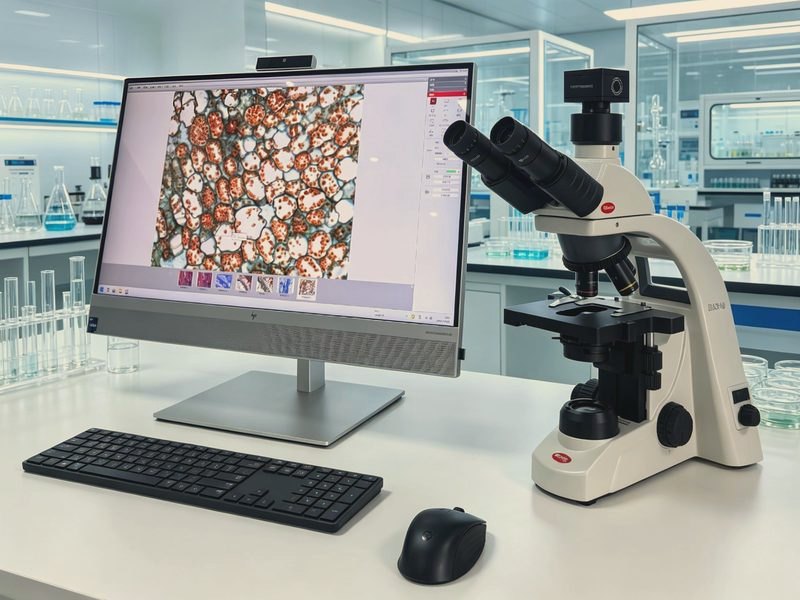
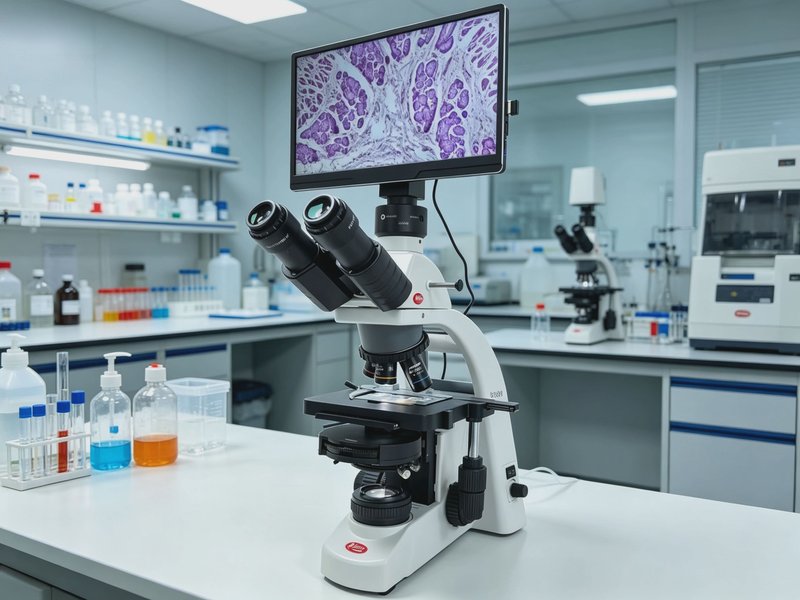
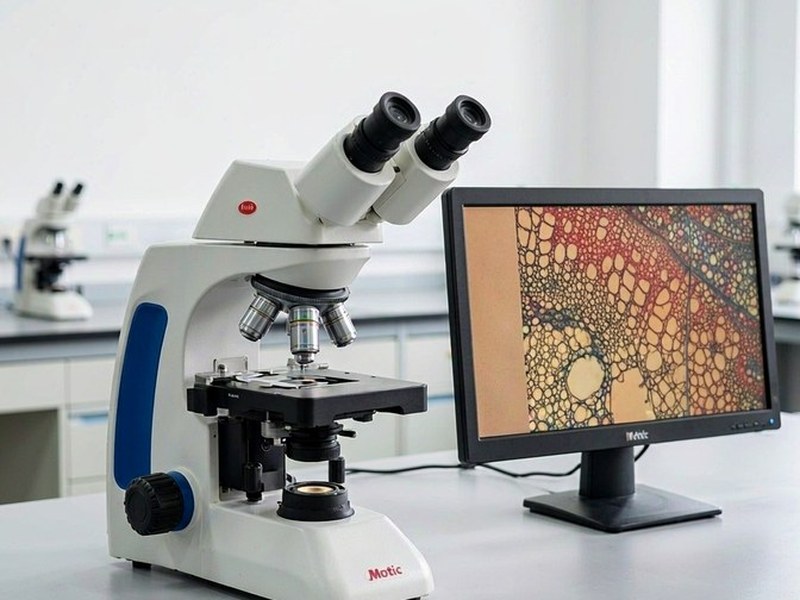
Digital Microscope Specifications
1. Optical system
• Infinity corrected optics with 4X, 10X, 40X and 100X oil objectives
• All-in-one models usually use fixed or continuous zoom objectives from 0.7X to 4.5X with digital scaling
• Parfocal distance of 45 mm for biological or 60 mm for industrial stands
• Light path straight to the sensor, no eyepieces, so no parallax between viewing and capture
2. All-in-one screen and host: the key difference
• Screen of 10 to 13 inches at 1920 by 1080 or higher
• Host integrated with the screen, processing and storage on board, no external computer
• Touch operation and mouse or keyboard both supported
• Brightness and colour should be calibratable, which matters for metallography and pathology
• HDMI output for a large screen on some models, useful for teaching and group viewing
3. Sensor and imaging
• CMOS sensor from 5 to 20 megapixels
• Optical format of 1 over 2.3 inch, 1 over 1.8 inch or one inch, larger giving more light per pixel and better low light behaviour
• Pixel size from 1.5 to 4.5 micrometres
• Full frame rate of 15 to 60 frames per second, with 30 or more advised for dynamic work
• Automatic and manual white balance, the manual mode being essential for stained or tinted samples
4. Magnification and field of view
• Optical magnification times digital magnification gives total screen magnification, and both should be stated separately
• Total magnification is usually referenced to a 21.5 inch monitor, so recalculation is needed on a built-in screen
• Low power for overview and high power for detail, a wider zoom range being more flexible
• Field diameter must match the sample, large industrial parts needing low power and a wide field
5. Illumination
• Reflected illumination by LED ring, coaxial light or dual gooseneck
• Transmitted illumination from a base LED for transparent samples and sections
• Continuous dimming with quadrant control on ring lights
• Polarising accessories for metallography and semiconductor work to suppress glare
6. Software and measurement
• Built-in measurement of length, angle, arc, area, perimeter and polyline
• Counting of particles and manual or automatic marking
• Image processing with contrast, sharpening, false colour and extended depth of field
• Calibration against a stage micrometer, with values switching automatically with objective
• Export of JPG and TIFF images and CSV or Excel measurement data
7. Interfaces and storage
• Storage on internal memory, SD card, USB drive or network share over SMB or FTP
• Video output over HDMI for large screens and USB for computers
• Data interfaces of USB 2.0 or 3.0 and Gigabit Ethernet
• WiFi with phone or tablet viewing on some models
• Report generation carrying the measurement data
8. Power and environment
• Power supply AC 220 V, 50 Hz
• Operating temperature 10 to 35 degrees Celsius
• Relative humidity up to 80 percent without condensation
• Away from strong vibration, which matters for high magnification measurement
• A dust cover and stabilised supply are advised on the shop floor
9. Where procurement goes wrong
• Only digital microscope is specified without screen magnification or sensor format, and the delivered magnification does not match, so measurement accuracy cannot be assured
• No stage micrometer calibration routine, so measurements are untraceable and inspection reports are not accepted
• The unit cannot drive an external screen, so teaching or consultation means one person looking at a small display