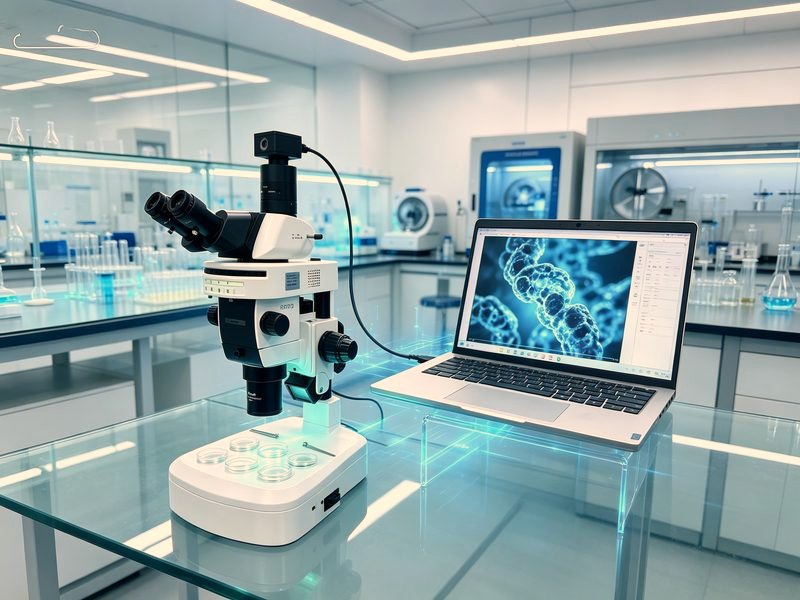
Stereo Fluorescence Microscope Specifications
1. Optical system and zoom
• Parallel optics or Greenough design, the former giving better stereopsis and coaxiality, the latter higher throughput
• Continuous zoom ratio of 6.7 to 1, 10 to 1 or 16 to 1, the larger ratio giving a wider range
• Total magnification around 8X to 80X with 10X eyepieces, up to 160X with a 2X objective
• Zoom knob with magnification scale for recording and reproduction
• Parfocal design so no refocusing is needed while zooming
2. Fluorescence light path: the key item
• Fluorescence module separate from the brightfield path, mounted above or beside the head
• Four or more channels, ultraviolet, blue, green and violet
• Common combinations for DAPI, GFP and FITC, TRITC and Texas Red
• Channel change by turret or slider without moving the sample
• Fluorescence and brightfield overlay on some models with dual paths
3. Filter sets and light source
• Each set comprising exciter, dichroic mirror and emitter
• Excitation and emission must match the fluorophore, and a wrong set shows nothing
• LED illumination with long life and instant control, or a 100 W mercury lamp with high output but warm-up and 200 to 300 hours life
• Independent LED channel switching to limit photobleaching
• Output must suit sample brightness, since excess power bleaches quickly
4. Working distance and aperture
• Working distance 100 to 115 mm, up to 180 mm on long working distance models
• Numerical aperture 0.3 to 0.5, higher aperture giving more resolution and less depth of field
• Long working distance leaves room for forceps and dissecting tools, which is the point of a stereo microscope
• Fitting fluorescence barely changes working distance but needs clearance in front of the objective
5. Stand and stage
• Stand types including pillar, boom, universal and transmitted base
• Stage plates in black and white for opaque samples, frosted glass for transmitted light, plus a mechanical stage
• Mechanical stage travel of at least 75 by 50 mm with scale for positioning
• Vibration demands are lower than upright or inverted, but a rigid bench is still advised for high magnification fluorescence
6. Illumination
• Reflected illumination by LED ring, dual gooseneck or coaxial light to remove shadows
• Transmitted illumination from a base LED or external source for transparent samples
• Ring light with four quadrant control to reveal surface texture
• During fluorescence the brightfield source must be off to avoid background contamination
7. Imaging and software
• Trinocular head with C mount, switchable between eyepieces and camera
• Sensors from 5 to 20 megapixels, with high sensitivity preferred for fluorescence
• Software for multichannel merging, intensity measurement and extended depth of field
• Overlay of fluorescence on brightfield for locating signal position
8. Power and environment
• Power supply AC 220 V, 50 Hz
• Operating temperature 15 to 30 degrees Celsius
• Relative humidity up to 70 percent
• A darkened environment gives the best fluorescence contrast
• Away from strong vibration and direct sunlight
9. Where procurement goes wrong
• Only two fluorescence channels are supplied, so after GFP and TRITC there is no room for DAPI and triple labelling fails
• A mercury lamp is supplied without LED, and at 200 to 300 hours per bulb the annual cost and downtime are high
• A short working distance model is chosen, and once the fluorescence module is fitted there is no room for instruments, losing the main advantage