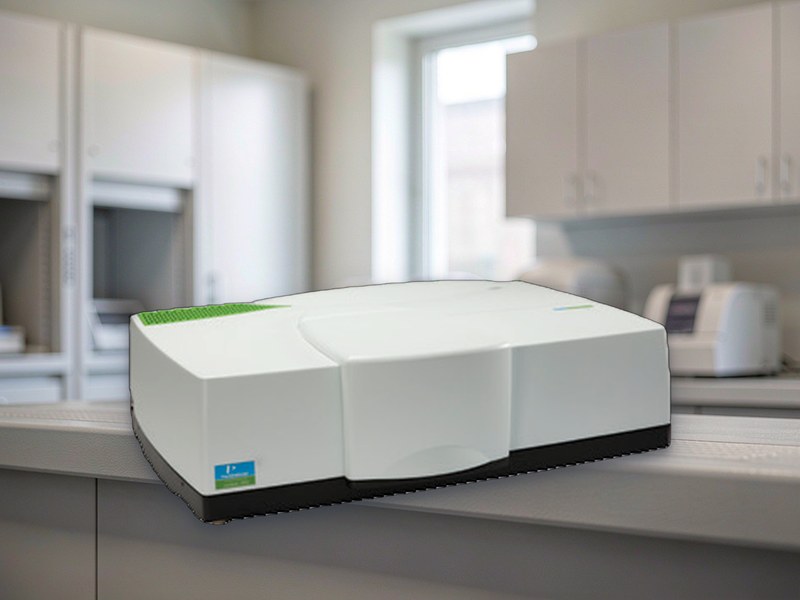
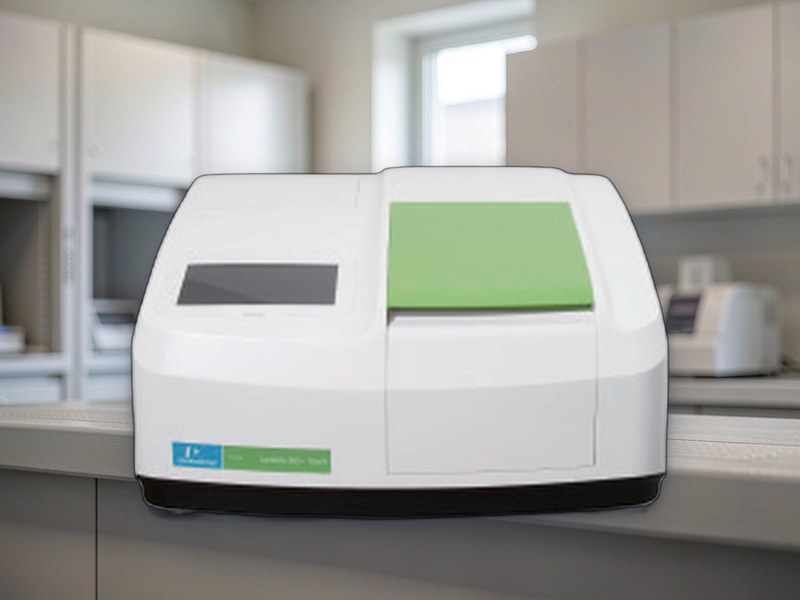
UV-Vis Spectrophotometer Specifications
1. Optical system
• Double beam design measuring sample and reference together, cancelling source drift and solvent absorbance
• Double monochromator on some models, lowering stray light for reliable high absorbance work
• Holographic gratings with coated optics for long term stability
• Automatic source change between deuterium for ultraviolet and tungsten halogen for visible, with a settable crossover
2. Wavelength range and accuracy
• Wavelength range 190 to 1100 nm as standard, 175 to 3300 nm on extended models
• Spectral bandwidth selectable at 0.5, 1, 2, 4 and 5 nm
• Wavelength accuracy within 0.1 nm at 1 nm bandwidth, verified on a deuterium emission line
• Wavelength repeatability within 0.05 nm
• Note: a narrower bandwidth raises resolution but lowers energy and raises noise, so choose by sample
3. Photometric performance
• Absorbance range minus 3 to 3, up to 4 on some models
• Photometric accuracy within 0.003 A at 1 A, verified with neutral density filters
• Photometric repeatability within 0.001 A
• Baseline stability within 0.0003 A per hour after warm-up
• Baseline flatness within 0.001 A from 200 to 900 nm
4. Stray light and resolution
• Stray light at or below 0.05 percent transmission by ASTM methods, checked at 220 nm with sodium iodide and 340 nm with sodium nitrite
• Double monochromator models reach 0.01 percent or better
• Stray light caps high absorbance measurement and matters most above 2 A
• Resolution verified on benzene vapour or holmium oxide peaks
5. Detectors
• Silicon photodiode covering 190 to 1100 nm
• Photomultiplier tube for high sensitivity on weak signals and low concentrations
• InGaAs for near infrared extended models
• The detector sets sensitivity and linear range, so favour sensitivity for trace quantification
6. Scan speed and data processing
• Scan speed adjustable, commonly 10 to 2400 nm per minute, above 4000 on fast models
• Scan speed interacts with bandwidth and response time, and too fast distorts the spectrum
• Time scan for kinetics, calibration curves and multi-wavelength quantification
• Processing including smoothing, derivatives, peak detection and area integration
7. Accessories
• Standard cell holder for 1 cm quartz cells, quartz being mandatory in the ultraviolet since glass absorbs
• Thermostatted cell holder with control within 0.1 degree, needed for enzyme kinetics and temperature sensitive samples
• Long path cells from 10 to 100 mm for trace quantification
• Integrating sphere for reflectance and diffuse transmission on solids, powders and turbid samples
• Micro and flow cells for small volumes and on-line measurement
8. Software and compliance
• Method management, audit trail of results and tiered user access
• Compliance features such as 21 CFR Part 11 and GLP data integrity as options
• Export to CSV and TXT plus dedicated reports
• IQ OQ PQ validation packages, required by pharmaceutical customers
9. Where procurement goes wrong
• Only UV-Vis spectrophotometer is specified without bandwidth or stray light, so data above 2 A are unusable
• A single beam model is used for long kinetics, where source drift goes straight into the result
• Glass cells are used in the ultraviolet, absorbing everything below 220 nm and suggesting the sample has no absorbance