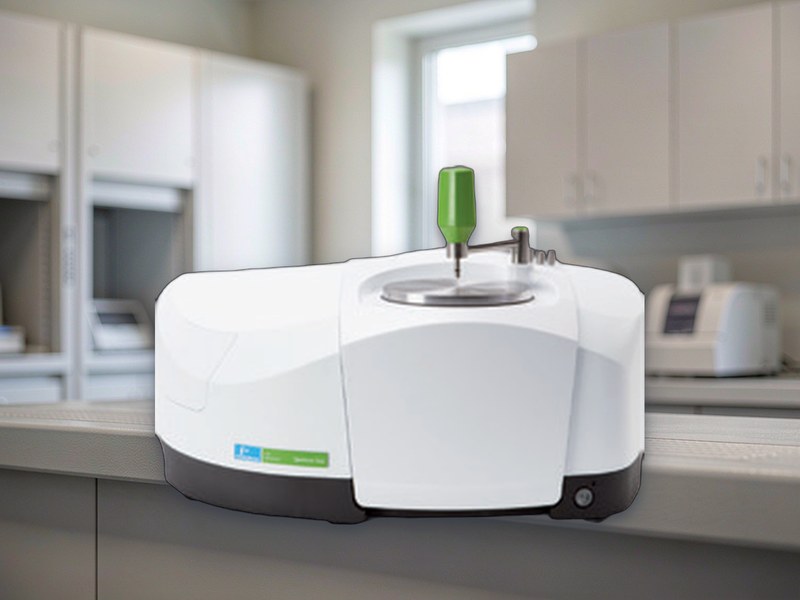
FT-IR Spectrometer Specifications
1. Optical system
• Fourier transform infrared path built on a Michelson interferometer
• Gold coated or moisture protected optics for humid environments
• Purgeable with dry air or nitrogen to suppress water vapour and CO2 interference
• Mid-infrared coverage as standard from 4000 to 400 reciprocal centimetres, extended models to 8300 to 350
2. Interferometer and resolution: the key item
• Dynamically aligned interferometer, correcting the light path during operation without manual adjustment
• Resolution better than 0.5 reciprocal centimetres, selectable at 0.5, 1, 2, 4 and 8
• Higher resolution means slower scans, 4 is sufficient for routine identification while gases and fine structure need 0.5 to 1
• Bearings or magnetic levitation in the interferometer for longer life and better stability
3. Wavenumber range and accuracy
• Wavenumber accuracy better than 0.01 reciprocal centimetres at 2000, verified on a polystyrene film
• Wavenumber repeatability better than 0.005
• Accuracy checked against a polystyrene standard, annual drift should stay within 0.1
• Note: wavenumber accuracy sets the library match rate, a poor instrument looks the same but hits far less often
4. Detectors
• DTGS detector, room temperature, stable, no liquid nitrogen, the usual choice for routine work
• MCT detector, high sensitivity and fast scanning but requiring liquid nitrogen, suited to rapid and trace analysis
• The detector type sets signal-to-noise ratio and scan speed, so state which one is included
• Indicative signal-to-noise ratio better than 30000 to 1 peak to peak at 4 reciprocal centimetres in one minute
5. Source and beamsplitter
• Mid-infrared source, air cooled ceramic or silicon carbide, long life and stable output
• Beamsplitter in KBr for general mid-infrared work, requiring dry conditions, or ZnSe which resists moisture
• In humid regions specify ZnSe or provide long-life desiccant, since KBr absorbs water and energy collapses
• The source and beamsplitter combination defines the usable range
6. Sampling accessories
• Diamond ATR, no sample preparation, pressing solids, powders and liquids directly, the most used accessory
• ZnSe ATR for soft materials and strong acids, avoiding scratches
• Transmission accessory with KBr pellets for quantitative work and high quality spectra
• Diffuse reflectance and specular reflectance for powders, coatings and films
• Gas and liquid cells as required
7. Software and libraries
• Library search against commercial libraries of tens to hundreds of thousands of spectra, with user libraries
• Quantitative analysis by peak height and area, multicomponent fitting and calibration curves
• Data processing including baseline correction, smoothing, derivatives, subtraction and normalisation
• Compliance features such as 21 CFR Part 11 audit trail, user levels and electronic signatures as options
• Export in common formats including JCAMP-DX and CSV
8. Power and environment
• Power supply AC 220 V, 50 Hz
• Operating temperature 15 to 30 degrees Celsius, drift within 2 degrees per hour
• Relative humidity up to 60 percent, lower at 50 percent with a KBr beamsplitter
• Away from strong vibration and electromagnetic interference, with a stabilised supply recommended
9. Where procurement goes wrong
• Only infrared spectrometer is specified without resolution or detector type, and 4 reciprocal centimetres with DTGS arrives, insufficient for gas or trace work
• A KBr beamsplitter is supplied in a humid region with no desiccation, and energy halves within six months
• No ATR accessory is included, so every solid sample needs a pellet and the instrument is rarely used