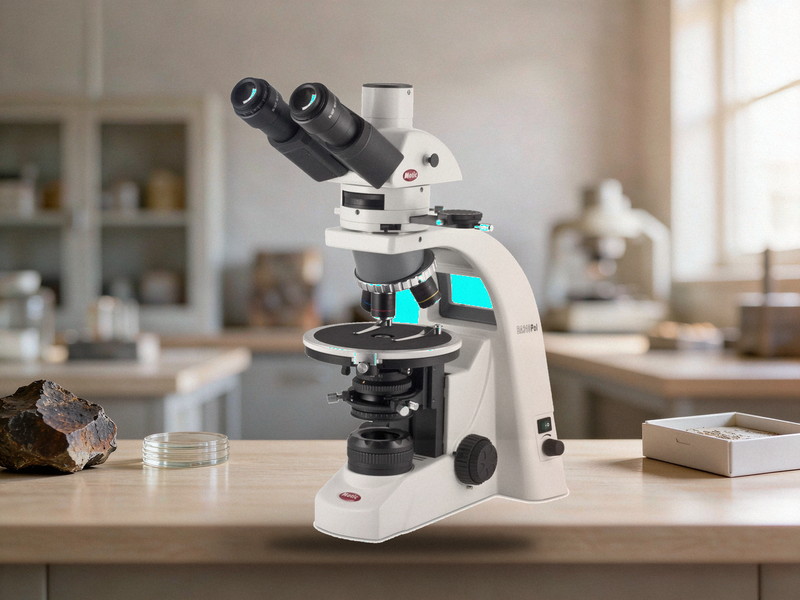
Polarizing Microscope Specifications
1. Optical system
• Infinity-corrected optical system, transmitted light path with incident light optional
• 45 mm parfocal distance
• Slots for polarizer and analyser, the analyser being swing-out
• Bertrand lens can be added for conoscopic observation of interference figures
2. Polarizing elements: the core item
• Polarizer rotatable through 360 degrees with an angle scale and a lockable 0 degree position
• Analyser swings in and out of the path, with a positive stop at the crossed 90 degree position
• With crossed polars the field goes dark, the basic check that the polarization system works
• Some models provide slots for a full wave plate and a quarter wave plate
3. Objectives: must be strain-free
• Strain-free plan achromat objectives: 4X, 10X, 20X, 40X, 60X
• Indicative numerical aperture: 4X 0.10 or more, 10X 0.25 or more, 20X 0.40 or more, 40X 0.65 or more, 60X 0.80 or more
• Objectives must be strain-relieved, ordinary objectives show spurious interference colours under crossed polars
• The 40X and 60X objectives resolve fine crystals and fibres
4. Rotating stage: a key item
• Circular stage rotating through 360 degrees with a 0.1 degree vernier
• Stage can be centred so the specimen does not drift while rotating
• Graduated rim for reading extinction angles and determining optic sign
• Stage diameter of 140 mm or more, taking thin sections and grain mounts
5. Compensators and conoscopic observation
• First order red plate, about 530 nm retardation, for judging the order of retardation
• Quarter wave plate for analysing elliptically polarized light
• Quartz wedge as an option, giving continuously variable retardation
• Bertrand lens switchable into the path for interference figures and optic axis determination
6. Illumination
• Transmitted illumination from LED or a 12 V 100 W halogen lamp, continuously dimmable
• Kohler illumination with adjustable field and aperture diaphragms
• Blue filter available for viewing comfort
• Incident illumination as an option for opaque minerals and metal crystals
7. Digital imaging
• C-mount on the trinocular head, accepting 5 to 20 megapixel cameras
• Colour fidelity matters in polarization work, so favour a camera with faithful colour
• Software supporting angle and retardation measurement, scale bars and report export
• Note: polarization effects in the camera optics or adapter disturb measurement, confirm the imaging path is polarization-free
8. Power and environment
• Power supply AC 220 V, 50 Hz
• Operating temperature 5 to 40 degrees Celsius, relative humidity up to 80 percent
• Keep away from strong magnetic fields and vibration, crystal observation demands stability
• Anti-fungus treated optics
9. Three points where procurement often goes wrong
• Objectives are not strain-relieved and coloured fringes fill the field under crossed polars, making observation impossible
• The stage cannot be centred, so the specimen drifts while rotating and angle measurement fails
• Only a polarizer is supplied without an analyser, or the analyser has no 90 degree stop, so the crossed position cannot be reproduced