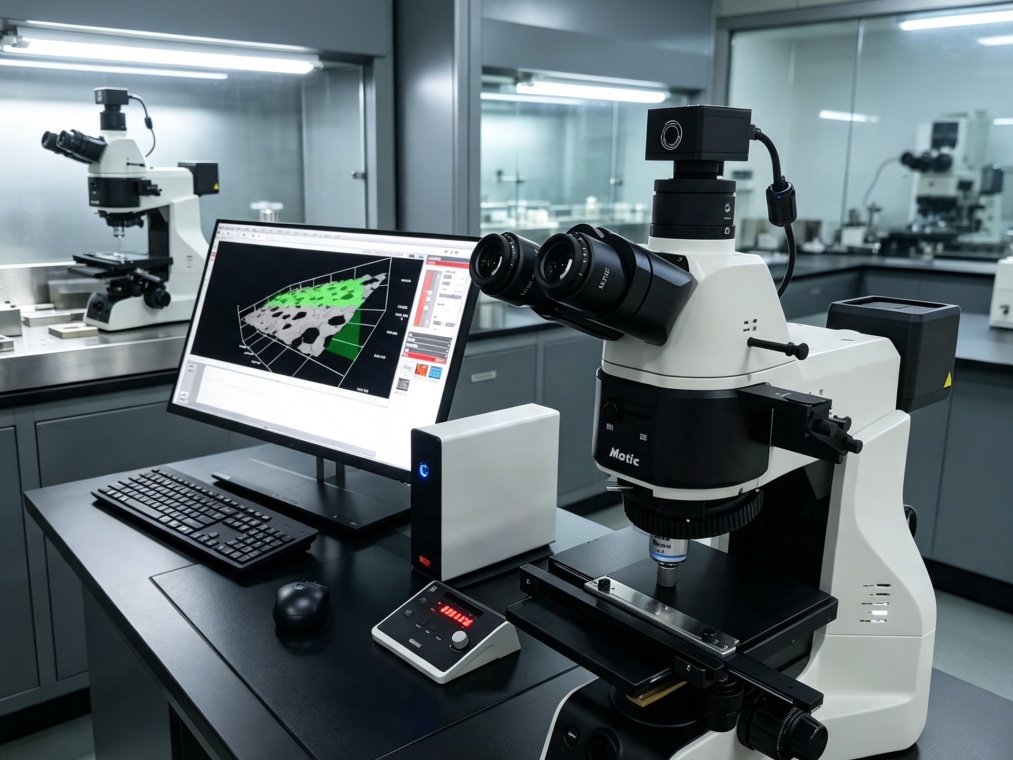
Metallurgical Microscope Specifications
1. Optical system
• Infinity-corrected optical system with an incident illumination path
• 45 mm parfocal distance
• Brightfield and darkfield share the same objectives, switched in the light path without changing objectives
• Slots for analyser and polarizer, allowing polarization to be added later
2. Objectives corrected for uncovered specimens
• Plan achromat objectives: 5X, 10X, 20X, 50X, 100X dry or oil
• Objectives corrected for 0 mm cover glass, viewing the polished surface directly with no coverslip
• Indicative numerical aperture: 5X 0.12 or more, 10X 0.25 or more, 20X 0.40 or more, 50X 0.75 or more, 100X 0.90 or more
• Brightfield and darkfield objectives of the BD type cover both modes with one set
• Note: biological objectives are corrected for 0.17 mm cover glass and produce spherical aberration and soft images on metallographic specimens
3. Illumination: brightfield and darkfield
• Incident illumination from LED or a 12 V 100 W halogen lamp, continuously dimmable
• Kohler illumination with adjustable field and aperture diaphragms, the aperture diaphragm controlling contrast and depth of field directly
• Darkfield by ring illumination or darkfield objectives, for inclusions, grain boundaries and coating defects
• Polarization with crossed polarizer and analyser, for distinguishing anisotropic phases
• Colour filters available in blue, green and neutral density
4. Stage
• Mechanical stage, travel of at least 100 x 100 mm
• Takes standard metallographic mounts of 25 to 40 mm diameter as well as thin sections
• Coaxial X and Y controls with vernier scales
• Stage height adjustable for specimens of different thickness
5. Focusing and light path switching
• Coaxial coarse and fine focusing, fine step of 0.002 mm or less, free of backlash
• Focus stop preventing objective contact with the specimen
• Brightfield and darkfield switched by slider or turret without shifting the field position
• Five-position nosepiece, parfocal across objectives
6. Polarization and DIC
• Polarizer rotatable through 360 degrees with scale
• Analyser can be swung out of the path, with a positive stop at the crossed position
• Full wave and quarter wave plates as options
• DIC attachment available as an option for surface relief and fine structure
7. Digital imaging
• C-mount on the trinocular head, accepting 5 to 20 megapixel cameras
• Metallography relies on reflected light, so a larger sensor helps on low-reflectance specimens
• Software supporting scale bars, grain size, coating thickness and report export
8. Power, environment and vibration
• Power supply AC 220 V, 50 Hz
• An anti-vibration table is recommended, vibration shows clearly at 50X and 100X
• Operating temperature 5 to 40 degrees Celsius, relative humidity up to 80 percent
• Specimens must be clean and dry, polished surfaces kept free of fingerprints
9. Three points where procurement often goes wrong
• Biological objectives mounted on a metallographic stand give permanently soft images that never come into full focus
• Only brightfield is specified, so inclusions and coating defects cannot be imaged for lack of darkfield
• The aperture diaphragm is fixed or has too narrow a range, forcing a choice between contrast and depth of field