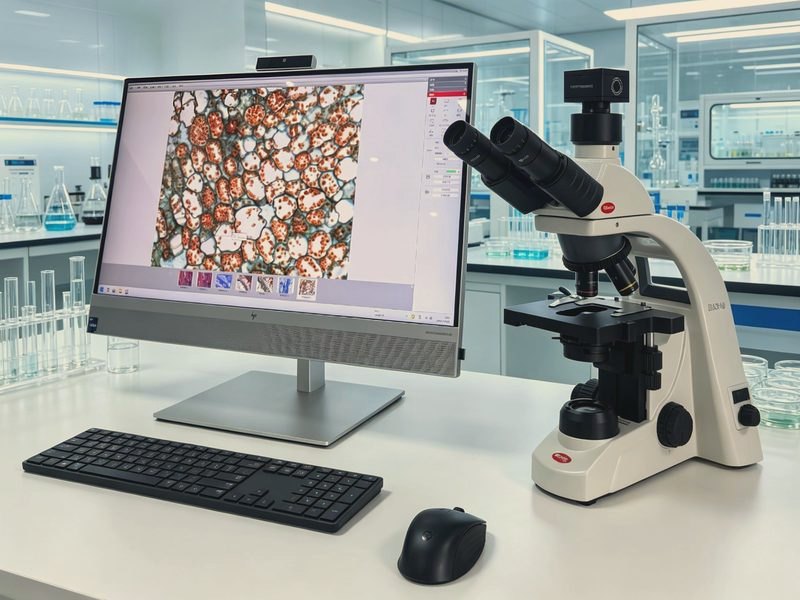
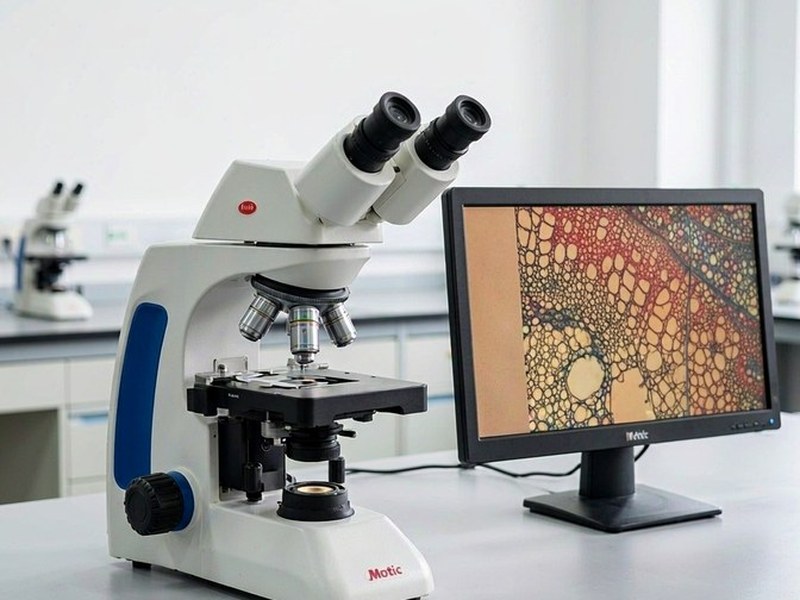
Biological Microscope Specifications
1. Optical system
• Infinity-corrected optical system, parallel light path between objective and tube lens
• 45 mm parfocal distance
• Polarizer, phase contrast, darkfield and fluorescence accessories can be added without degrading the image
• Coated optics for stable transmission and contrast, no coating loss over time
2. Heads and eyepieces
• Binocular or trinocular head, 30 degree inclination, 360 degree rotation
• Interpupillary distance adjustable from 48 to 75 mm
• Trinocular split ratios typically 100:0 or 20:80, allowing simultaneous viewing and imaging
• 10X wide-field eyepieces, field number 20 mm or larger
• Dioptre adjustment available as an option
3. Objectives: numerical aperture sets resolution
• Plan achromat objectives: 4X, 10X, 40X, 100X oil
• Indicative numerical aperture: 4X 0.10 or more, 10X 0.25 or more, 40X 0.65 or more, 100X 1.25 or more
• Plan correction: edge and centre sharp at the same time, most visible at 40X and 100X
• 100X oil objective working distance around 0.15 to 0.20 mm, used with cedar oil
• Note: numerical aperture sets the theoretical resolution, magnification alone adds no detail
4. Stage
• Graduated mechanical stage, travel of at least 75 x 50 mm
• Vernier scales for returning precisely to the same field
• Slide holder and coaxial or separate X and Y controls
• Corrosion-resistant surface, can be wiped with alcohol
5. Focusing and illumination
• Coaxial coarse and fine focusing, fine step of 0.002 mm or less, free of backlash
• Focus stop and tension adjustment to prevent crushing the slide
• Transmitted LED illumination, continuously dimmable (some models use a 30 W halogen lamp)
• Kohler illumination with adjustable field and aperture diaphragms
• LED colour temperature 4000 to 6000 K, no warm-up, long life, low heat
6. Condenser and expansion options
• Abbe condenser, numerical aperture 1.25 or more, height adjustable and centreable
• Phase contrast kit with 10X, 20X, 40X and 100X rings, matched one to one with the objectives
• Darkfield and simple polarization kits as options
• Incident fluorescence attachment in B and G channels as an option
7. Digital imaging
• C-mount on the trinocular head, accepting 5 to 20 megapixel cameras
• Sensor size from 1/1.8 inch to 1 inch, larger sensors performing better in low light
• Imaging software supporting measurement, annotation, scale bars and report export
8. Power and environment
• Power supply AC 220 V, 50 Hz
• Operating temperature 5 to 40 degrees Celsius, relative humidity up to 80 percent
• Anti-fungus treated optics for humid conditions
• Dust cover and anti-vibration table recommended, noticeable at high magnification
9. Three points where procurement often goes wrong
• Only achromat is specified rather than plan achromat for 40X and 100X, leaving the edge of the field soft, most obvious in photographs
• The 100X oil objective is specified without stating whether immersion oil is required
• Condenser numerical aperture lower than that of the objective, for example 0.9 with a 100X/1.25 objective, so the stated resolution cannot be reached at high power