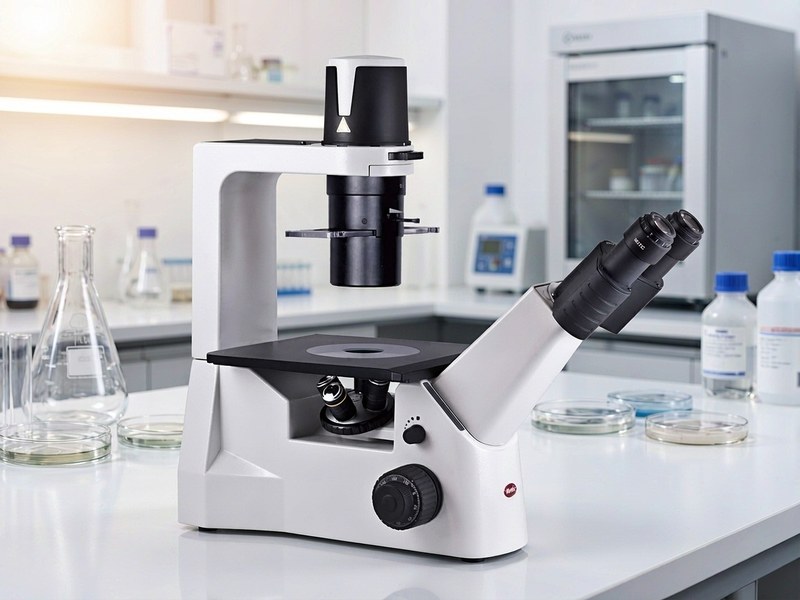
Inverted Microscope Specifications
1. Optical system
• Infinity-corrected optical system, parallel light path between objective and tube lens
• Polarizer, phase contrast and fluorescence accessories can be added to the light path without degrading the image
• 45 mm parfocal distance, so accessories remain interchangeable and the system can be expanded later
2. Heads and eyepieces
• Trinocular head, 30 degree inclination, 360 degree rotation
• Interpupillary distance adjustable from 48 to 75 mm
• Eyepiece observation and camera imaging available at the same time (split ratios typically 100:0 or 20:80)
• 10X wide-field eyepieces, field number 20 mm or larger
3. Objectives: long working distance
• Long working distance plan achromat objectives: 4X, 10X, 20X, 40X
• Indicative working distances: 4X 15 mm or more, 10X 8 mm or more, 20X 6 mm or more, 40X 2.6 mm or more
• Parfocal and parcentred, imaging directly through the base of dishes and flasks
• Note: ordinary biological objectives usually work at less than 1 mm and cannot focus through a vessel wall, so the tender should state long working distance explicitly
4. Stage
• Mechanical stage, travel of at least 120 x 78 mm
• Supplied with dish holder, flask holder and slide holder, so vessels go straight on
• Corrosion-resistant surface, can be wiped with alcohol
• Low-position coaxial controls to reduce fatigue during long sessions
5. Focusing and illumination
• Coaxial coarse and fine focusing, fine focus step of 0.002 mm or less, free of backlash
• Stage elevation focusing, avoiding objective contact with the sample
• Transmitted LED illumination, continuously dimmable (some models use a 30 W halogen lamp, now largely replaced by LED)
• Kohler illumination with adjustable field and aperture diaphragms
• LED colour temperature 4000 to 6000 K, no warm-up, long life
6. Phase contrast and fluorescence
• Phase contrast kit with 10X, 20X and 40X rings, matched one to one with the objectives
• If a ring does not match the objective, there is no phase effect at all, the most common configuration error in procurement
• Fluorescence available in B and G channels, selected according to the labels used
• Fluorescence source may be LED or mercury; LED needs no warm-up, mercury is brighter at specific lines but short-lived
7. Digital imaging and interfaces
• C-mount on the trinocular head, accepting 5 to 20 megapixel cameras
• Sensor size from 1/1.8 inch to 1 inch, larger sensors performing better in low light
• Imaging software supporting measurement, annotation and report export
• Ports for micromanipulators and perfusion systems for live-cell and patch clamp work
8. Power, environment and build
• Power supply AC 220 V, 50 Hz
• Operating temperature 5 to 40 degrees Celsius, relative humidity up to 80 percent
• Sealed, anti-fungus treated optics, suited to humid climates
• Bench load capacity of at least 15 kg
9. Where tender responses go wrong
• The tender asks only for an inverted microscope without requiring long working distance, and the delivered unit cannot take a culture flask
• The number of phase rings does not match the number of objectives, so a magnification is missing at acceptance
• Pixel count and sensor size do not match, for example 20 megapixels on a 1/2.3 inch sensor, producing visible noise in low light and falling short of expectations in practice
To adapt these specifications to a specific project, or to obtain full technical documentation for a particular model, contact us and we will propose a configuration around your application.