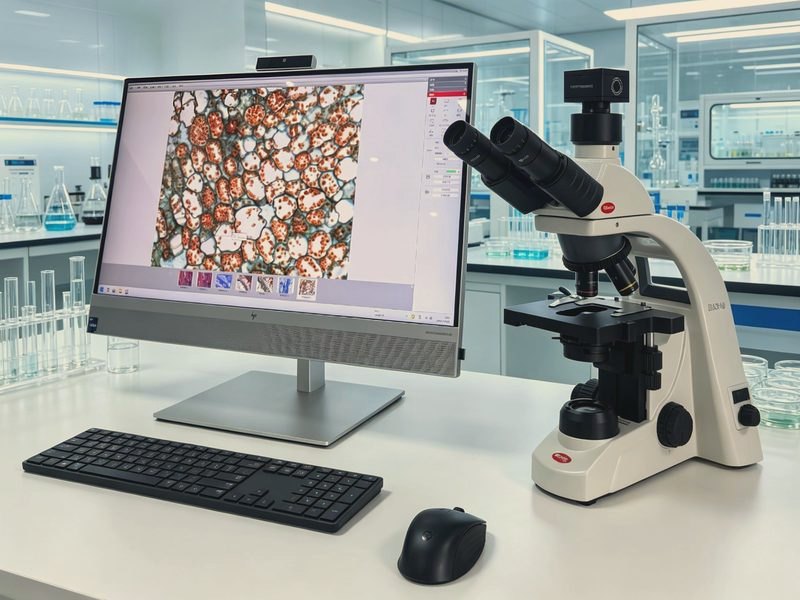
Choosing a Biological Microscope: Six Parameters That Matter
A biological microscope is the most common instrument in medical schools, biology laboratories and hospital pathology departments, and prices run from a couple of thousand yuan to well over a hundred thousand. Faced with a long list of models and specifications, many buyers get stuck: how should this actually be chosen? In practice, six key parameters keep the decision on track.
1. Optical system: insist on infinity correction
The mainstream of modern biological microscopy is the infinity-corrected optical system. Light leaving the objective becomes a parallel beam and is focused by the tube lens. The benefit is that polarizers, fluorescence attachments and other accessories can be inserted into the light path without degrading the image, which makes the system far more expandable. If the budget allows, choose an infinity-corrected system rather than an older finite-tube one.
2. Objectives: numerical aperture sets resolution
The objective is the heart of the microscope. The larger the numerical aperture (NA), the finer the detail that can be resolved. The usual set is 4X, 10X, 40X and 100X oil. The 40X and 100X matter most: for research work choose plan apochromats (Plan Apo), which keep color and the edges of the field flat; for teaching and routine inspection plan achromats (Plan Achromat) are sufficient and better value. With a 100X oil objective, also check whether no-oil or semi-apochromat options are available.
3. Eyepieces and total magnification
The common eyepiece is 10X, which combined with 4X to 100X objectives gives 40X to 1000X total magnification. Note that more magnification is not automatically better: beyond the useful limit set by the objective's numerical aperture the image only gets softer. Judge an instrument by its useful magnification range rather than by who quotes the biggest number.
4. Illumination: Kohler and dimmable light
Good illumination decides image contrast directly. The standard setup is Kohler illumination with adjustable field and aperture diaphragms, using an LED source: continuously dimmable, long-lived and cool. Older halogen lamps run hot, blow bulbs and are now steadily being replaced by LED. When checking, look for even illumination and no dark corners.
5. Stage and focus: mechanical precision
Choose a mechanical stage with vernier scales so the specimen can be moved smoothly in X and Y. The focusing block should be coaxial coarse and fine, with a fine focus that is precise and free of backlash. For research use, judge how smoothly and repeatably the stage travels; for teaching, durability and ease of operation count for more.
6. Camera and imaging: digital is the norm
More and more laboratories now expect digital imaging. Three things matter in a camera: pixel count (commonly 5 to 20 megapixels), sensor size (a larger sensor performs better in low light) and frame rate (dynamic observation needs a high frame rate). Also confirm that the camera-to-microscope mount matches, C-mount being the most common, and whether the accompanying imaging software is actually pleasant to use.
In short: teaching instruments should be judged on durability and value, research instruments on objective quality and imaging, and the two should not be compared on price alone. When buying, ask the supplier to propose a configuration around your real samples and working conditions instead of quoting a single total figure. Choose well and the instrument serves you for ten years; choose badly and it is in repair every other month. Nowhere is that saying truer than with a microscope.